Fort Dodge Broadcasting: A History · Chapter 3 of 9
On this page
KQTV / KVFD-TV: Fort Dodge television, 1953–1977
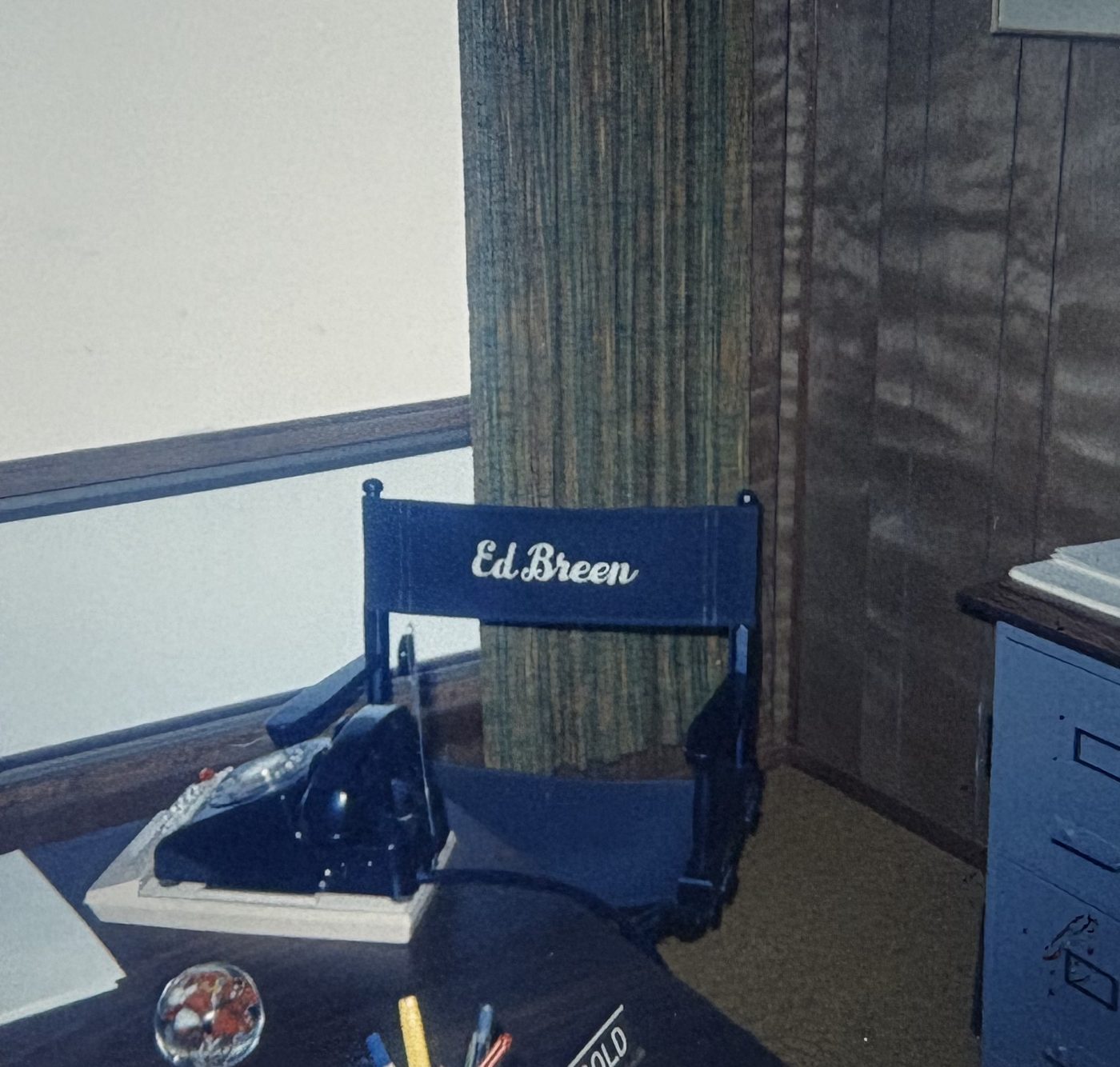
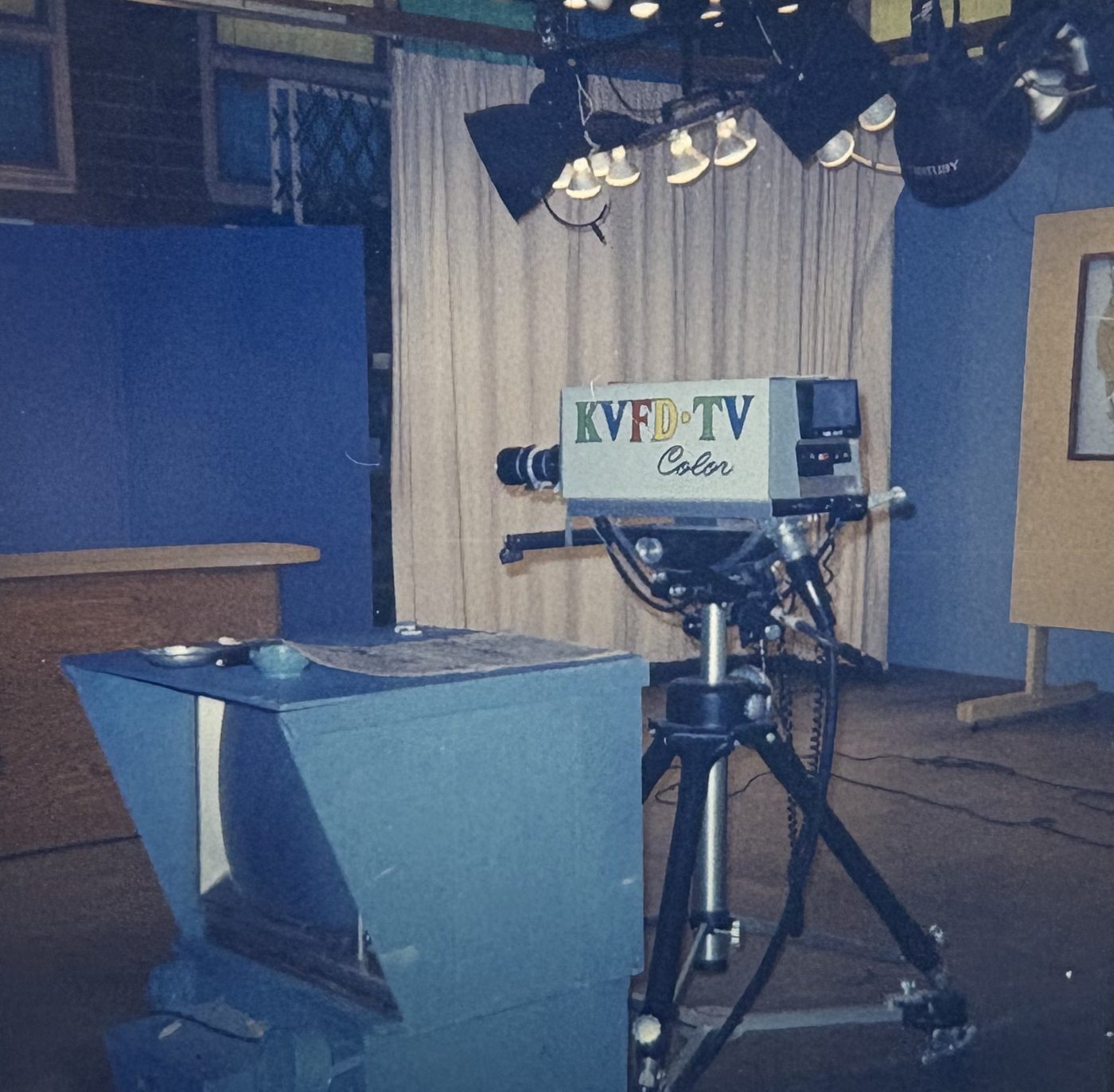
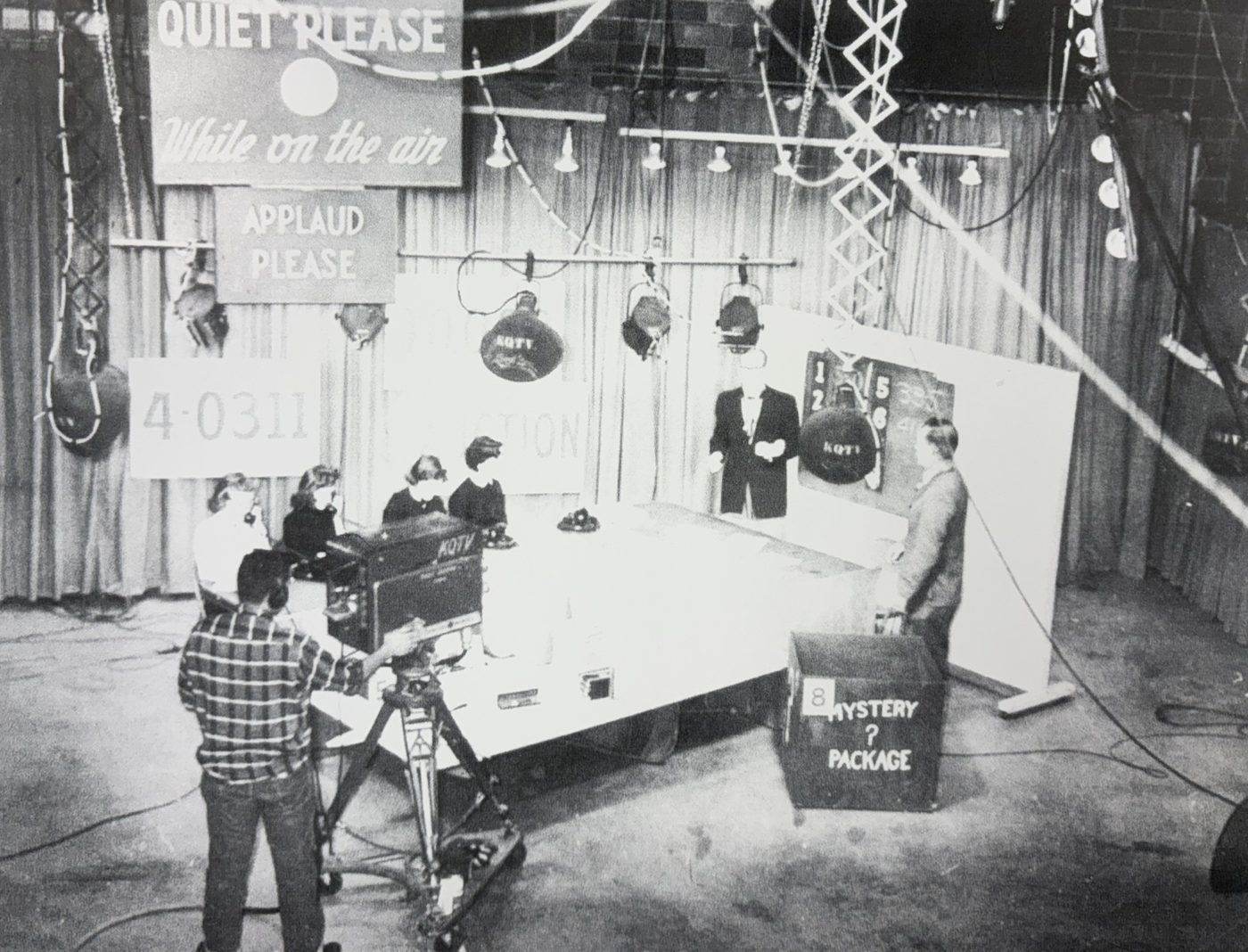
Fort Dodge had its own television station for 24 years. KQTV signed on November 23, 1953 on UHF channel 21, owned by Ed Breen's Northwest Television Company, and it was the city's only commercial TV station. It started small: in its first year it was on the air from 4:15 to 10:30 each evening, from one 40-by-40-foot studio with a single camera, and a 650-foot tower.
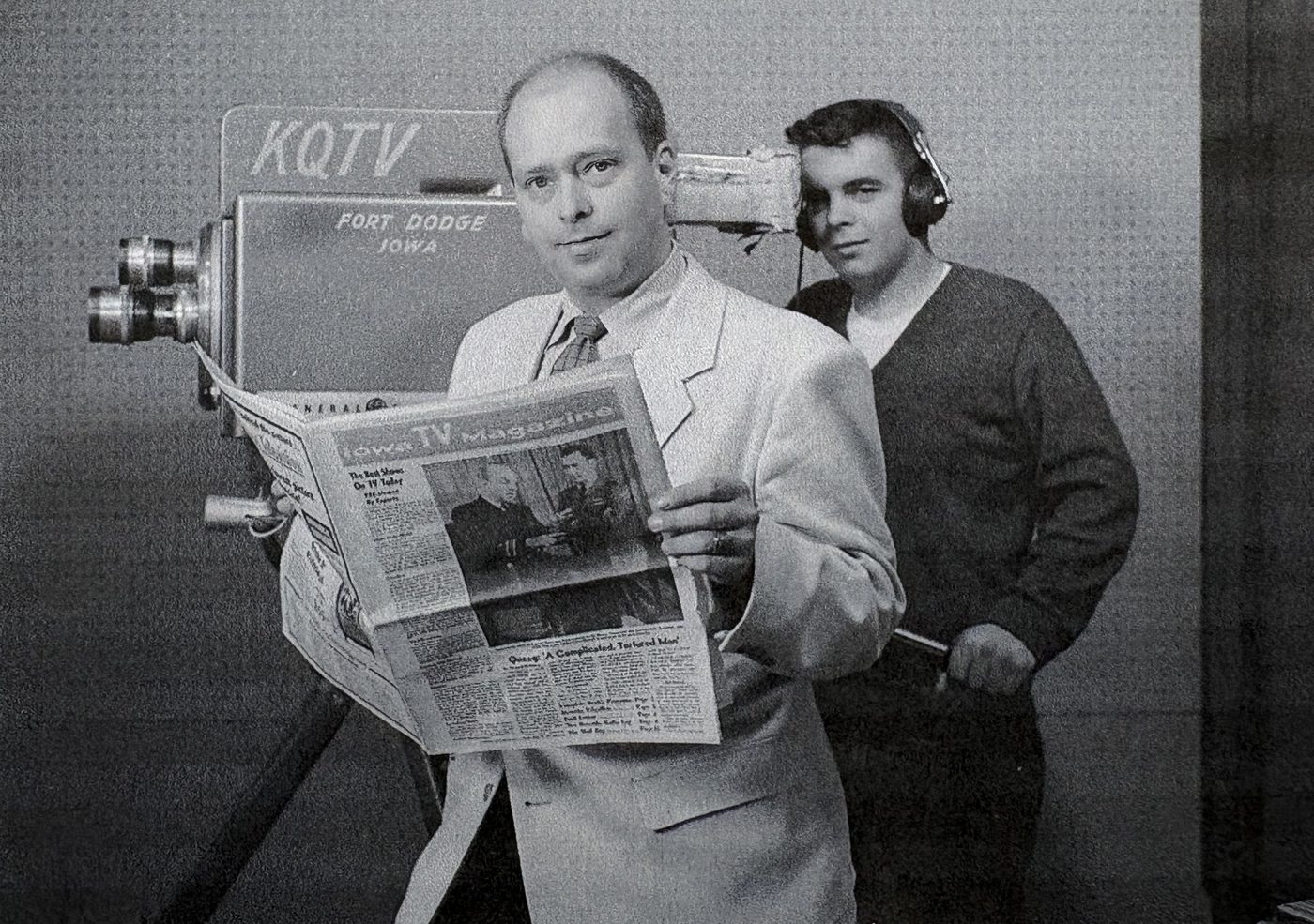
The FCC had granted its construction permit on January 29, 1953; KQTV signed on at 18,000 watts and was up to 170,000 by 1955. Breen called the early years "a horrible struggle." "We're over the hump now and making money," he said in 1966, "but what a battle it was. One major problem was that we were pioneers in the UHF field."
News and network sharing with WHO-TV. KQTV was an NBC affiliate that also carried ABC, CBS and DuMont programs in its early years. It picked up NBC's feed off the air from WHO-TV in Des Moines, whose own signal was too weak in Fort Dodge to compete, and its network schedule included Huntley-Brinkley and Wednesday Night at the Movies. It ran local news at 6 and 10 p.m., anchored by Breen, who also delivered his commentary It Seems to Me; Bob Brown called Breen the area's first TV news anchorman.
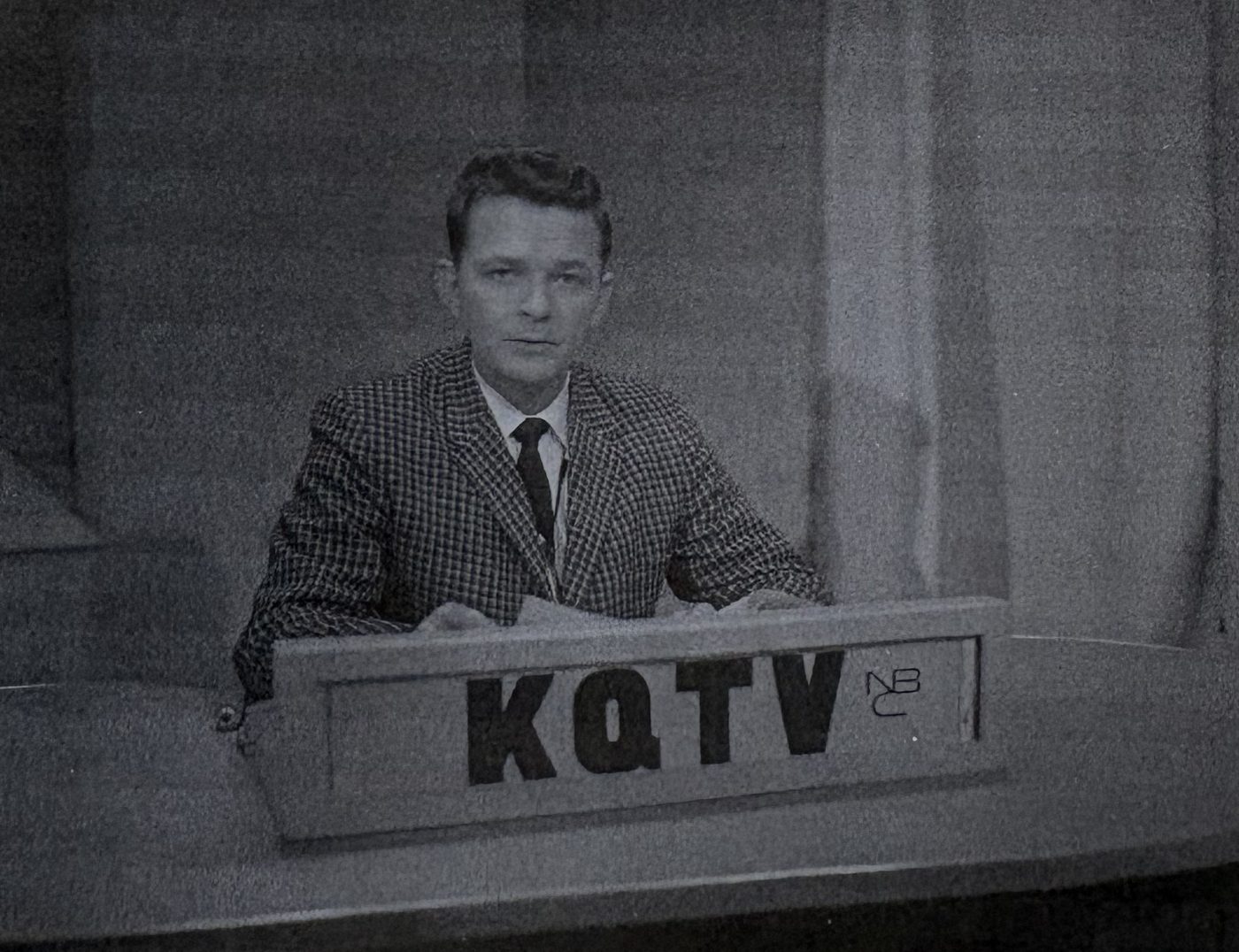
Breen staffed the TV station largely with his radio people. Bob Dean came to KVFD in 1956 after radio jobs in Huntsville and Decatur, Alabama, and stayed 30 years, until poor health forced his retirement in 1986. He was the radio station's news director for nearly all of that time and ran the TV newsroom as well through the 1960s and into the early '70s. Program Director Drexel Peterson, Dick Johnson, Bob Brown and Bill Higgins also worked on both radio and TV. In 1973 Bob Tarbox took over as TV news director and held the job until the station went dark in 1977, while Dean stayed with radio. Roy Chase left KWMT in 1972 to become KVFD-TV's weatherman and sportscaster, and stayed until the tornado took the station off the air.
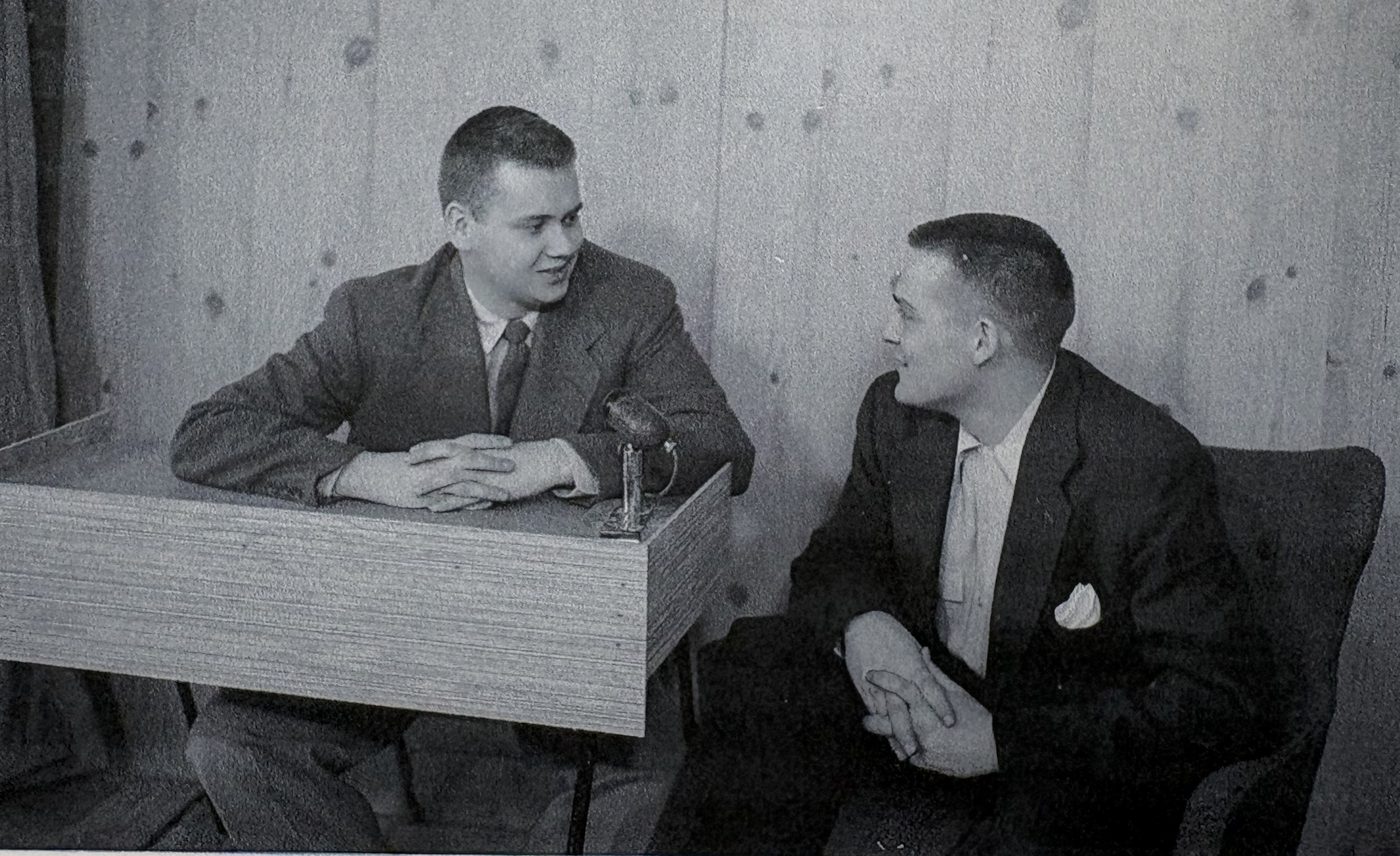
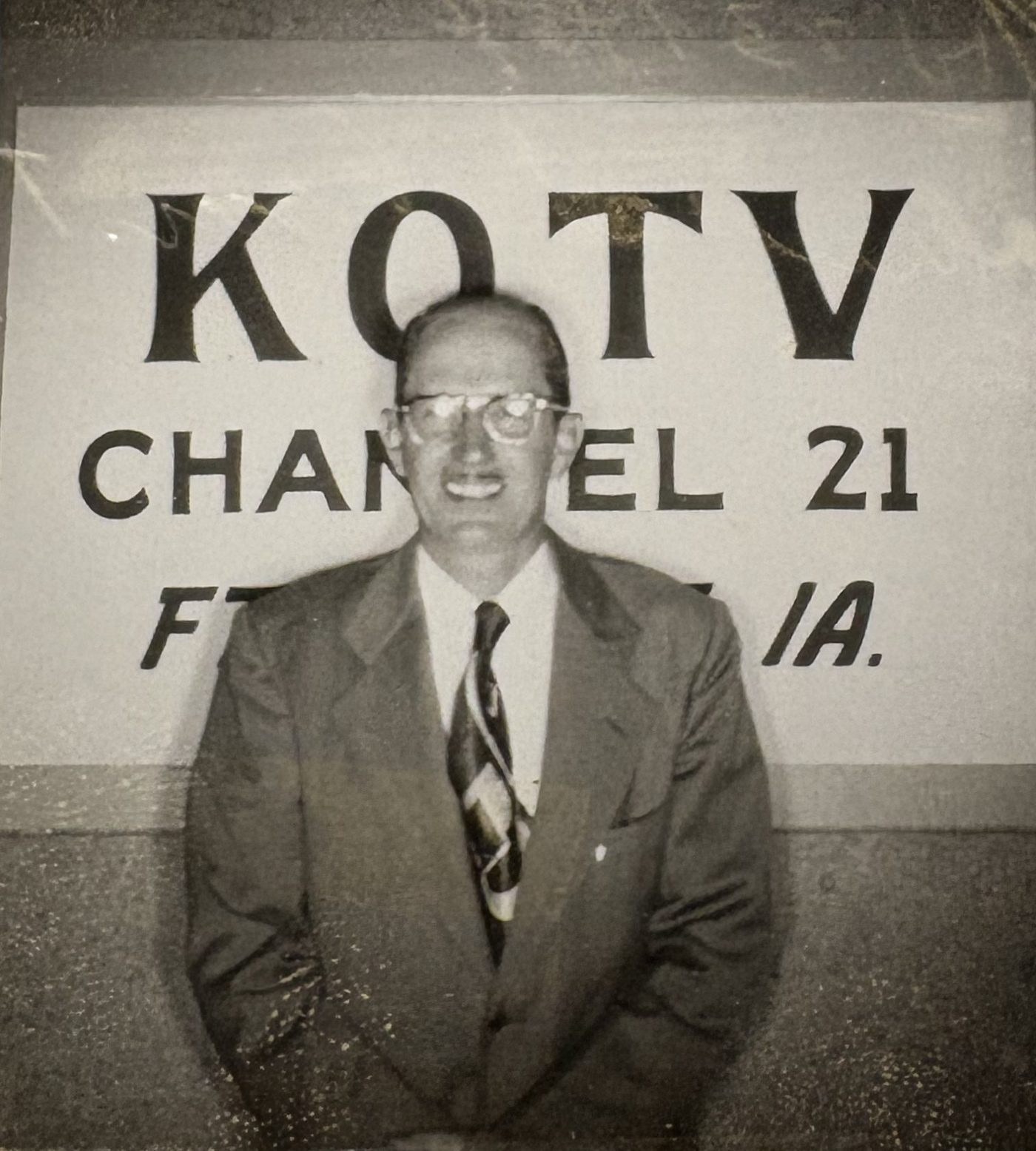
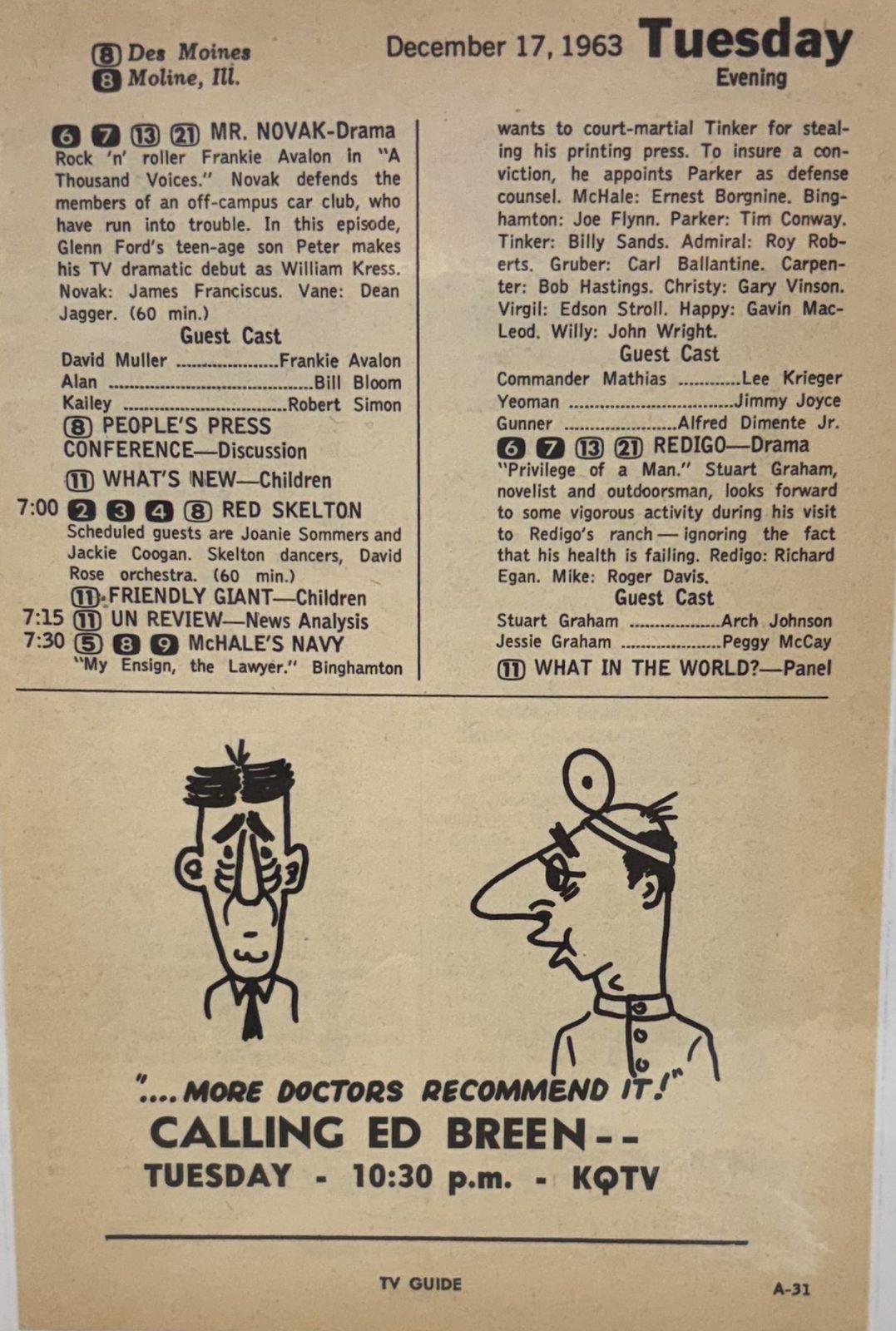
Behind the scenes, David G. Sinclair kept both stations on the air: he came to KVFD in 1941, was its chief engineer from 1942 to 1972 and vice president of engineering for KQTV and KVFD from 1952 to 1977, and also handled radio communications for the Fort Dodge police and fire departments and the Webster County sheriff. Breen also hosted Conference Table, an interview show with local and state newsmakers, and Calling Ed Breen, a weekly half-hour call-in show on Tuesdays at 10:30 p.m.
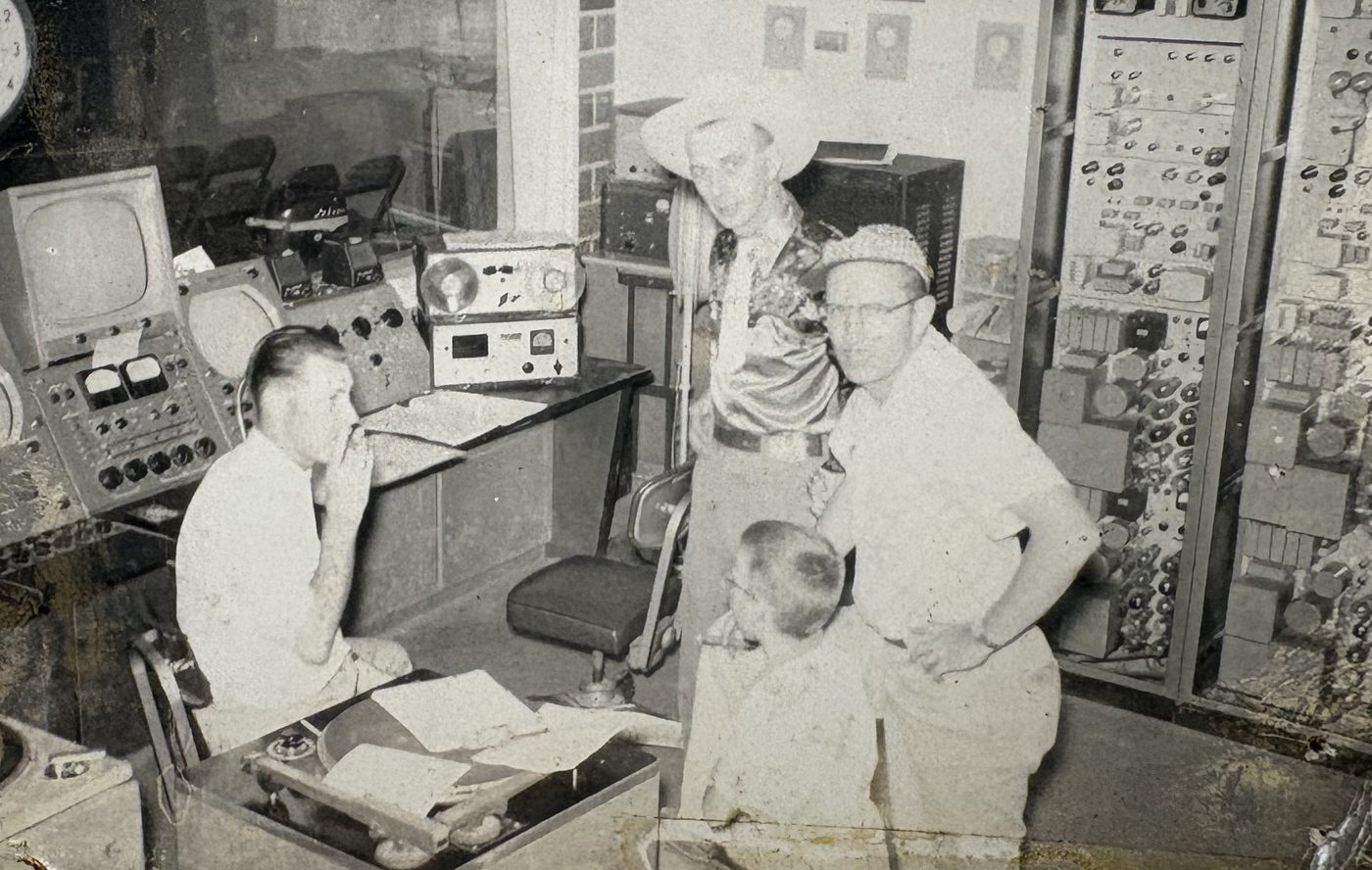
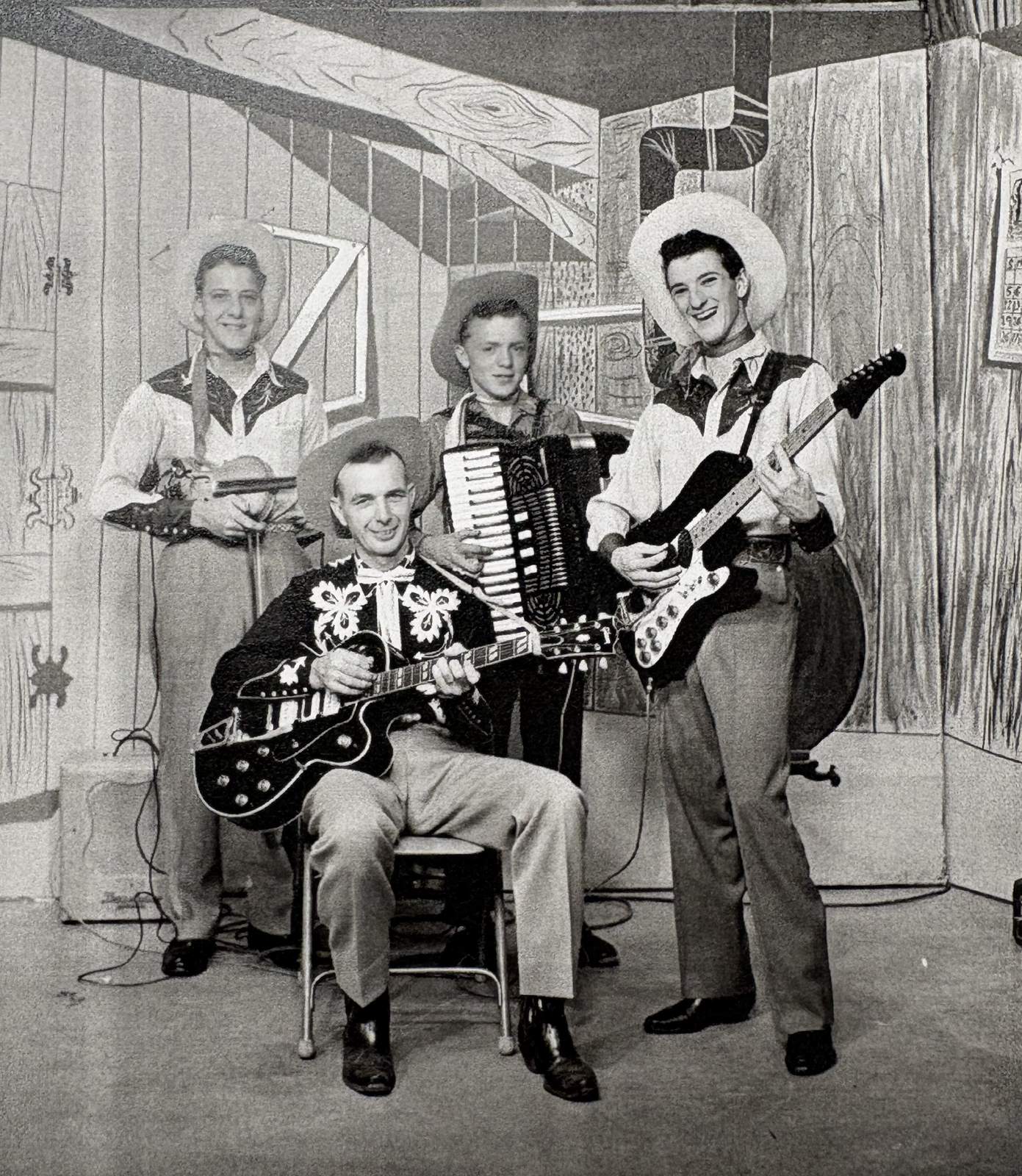
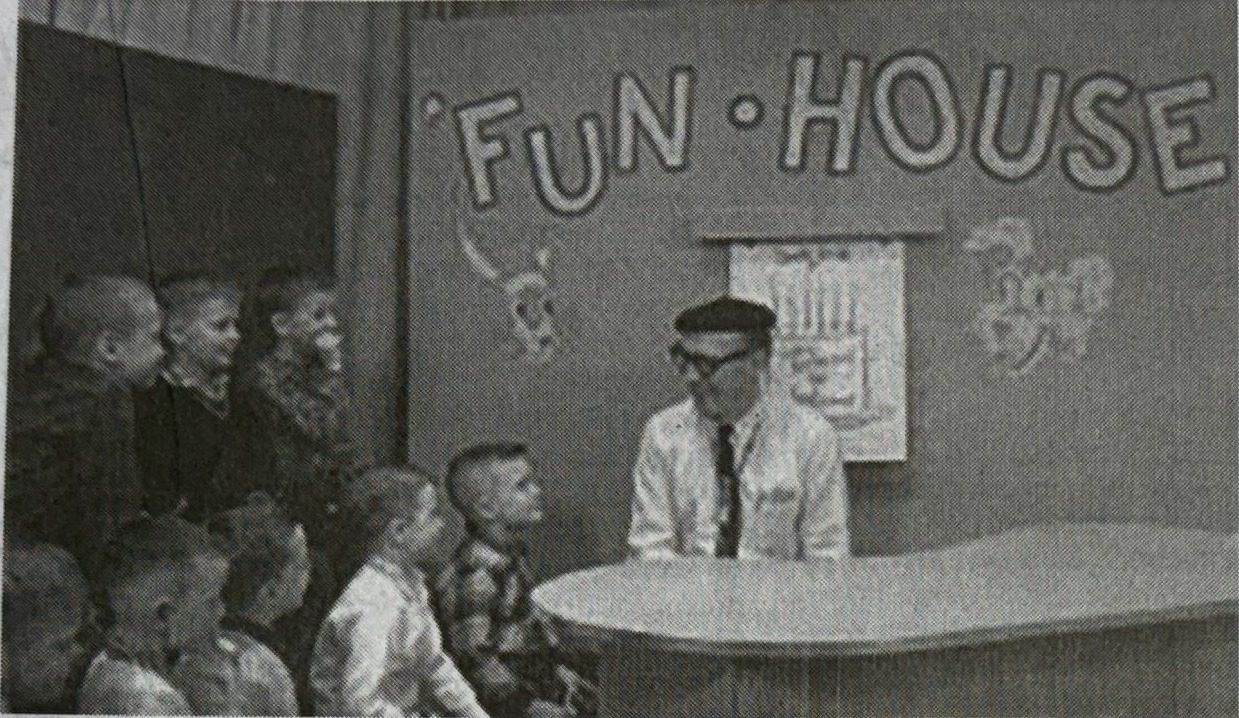
Popular local shows and personalities. Local shows included Saturday Night Barn Dance, Uncle Dick's Fun House with Dick Johnson, and a weekday-morning Romper Room. The Barn Dance, hosted by Dee Coleman and Bobby Awe, ran until April 15, 1972.
Fun House aired at 5 p.m. until 1968, when it was cut to a 15-minute Birthday Party, and it ended in 1970; Johnson, who had joined KVFD radio in 1953, also did weather and news. The show was Breen's idea. Johnson remembered being called into his office and told, "Starting next Monday, you'll have the 5 to 5:30 slot after Eve." With no videotape, Johnson filled the time between commercials and film by drawing pictures for the kids, and nearly every day brought a birthday party. He later did television news in Great Falls, Montana, and died there in 2024 at 95.
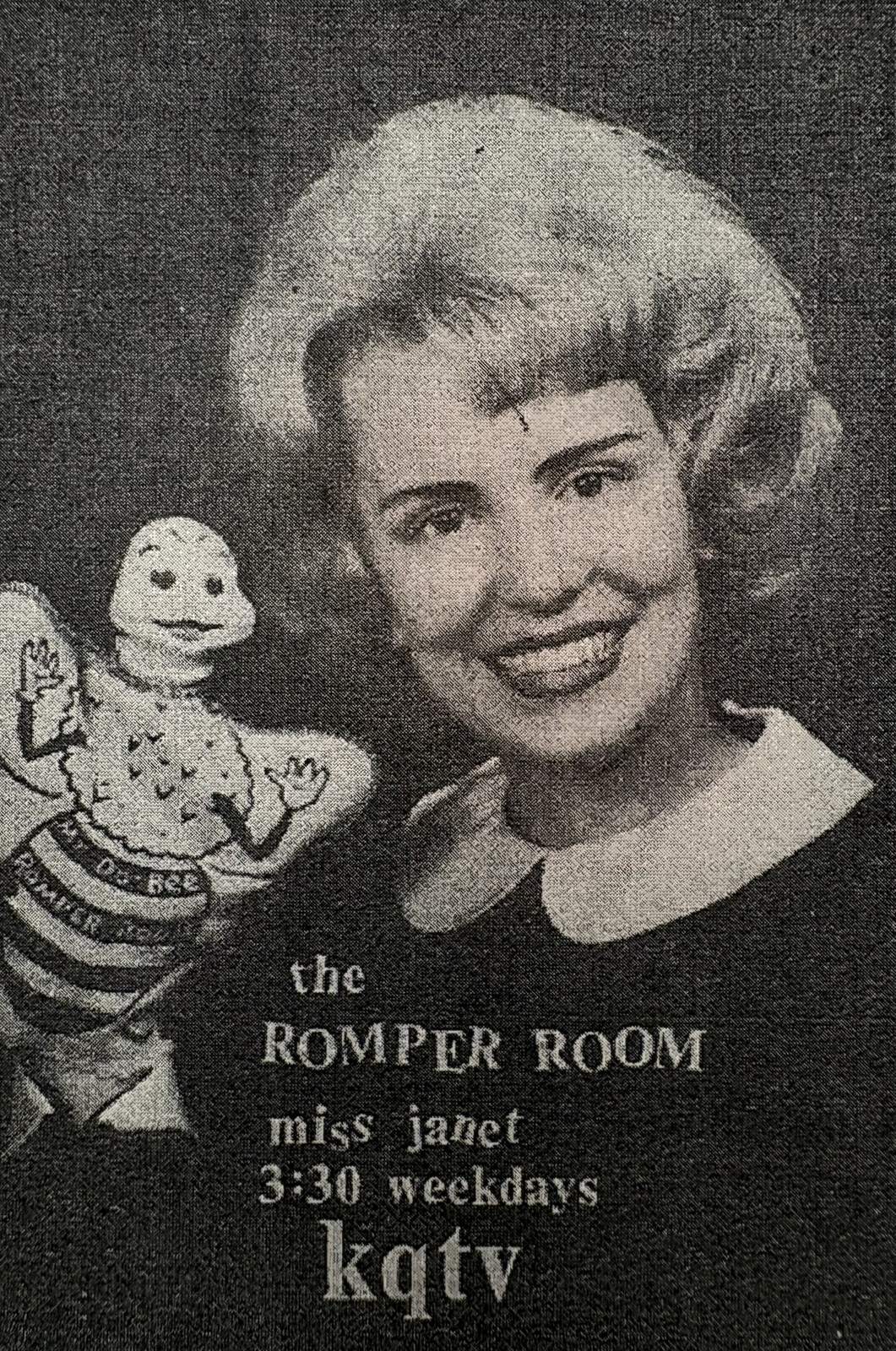
Romper Room was a national franchise in which each station supplied its own teacher. It had started on WHO-TV in 1954 before coming to KQTV, where Fort Dodge's teacher was Janet Wiewel, "Miss Janet"; except for most of 1964, the show ran until February 1970.
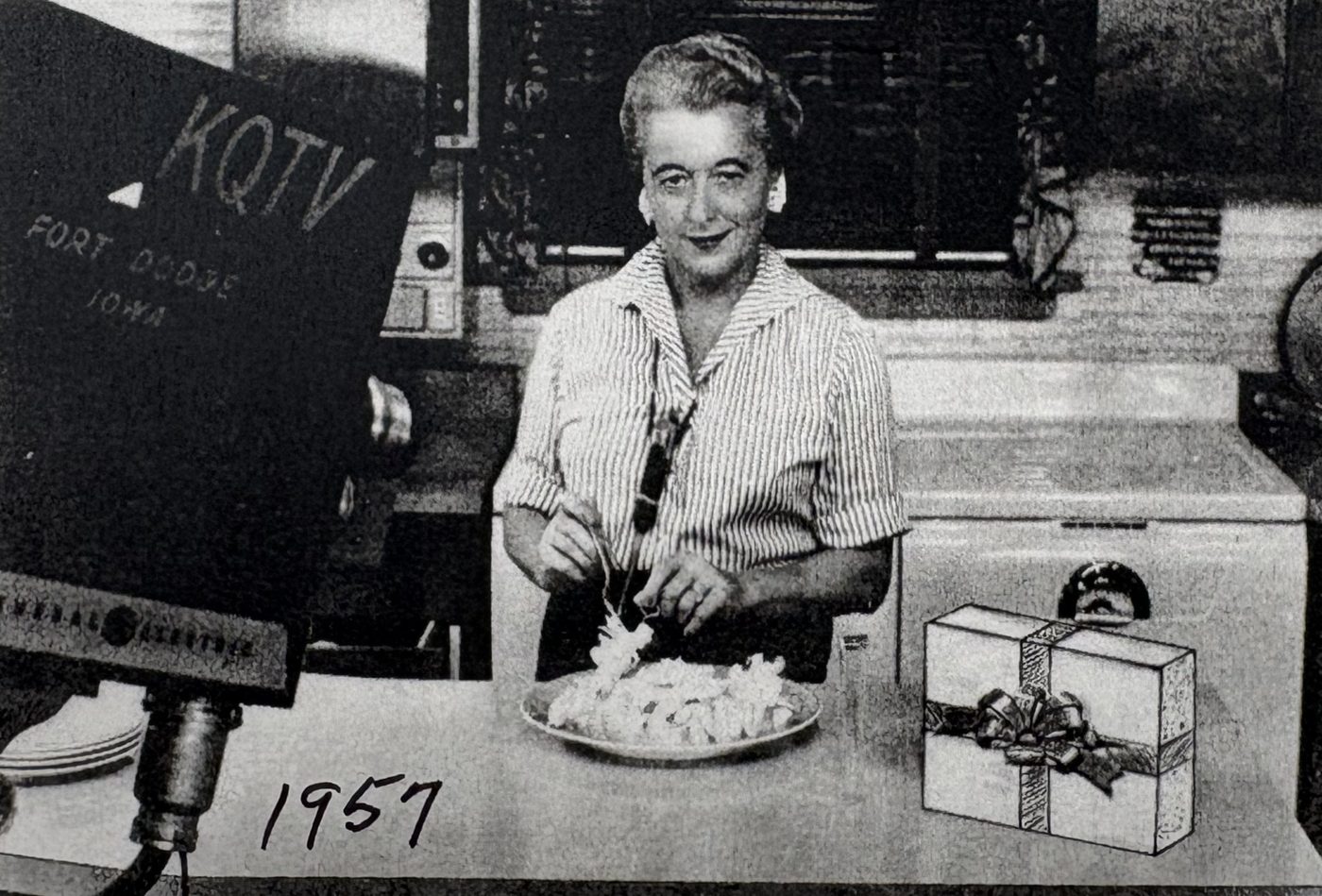
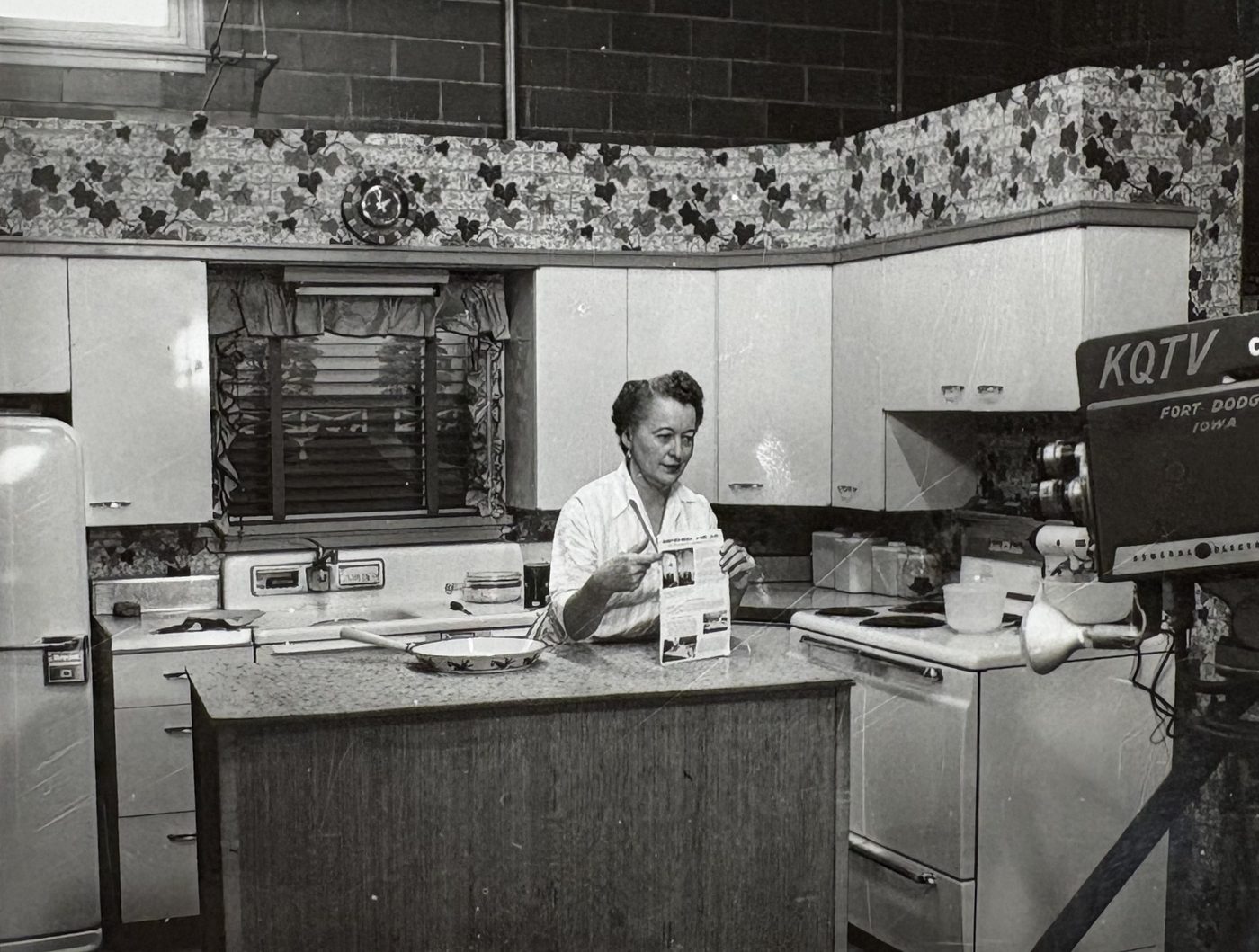
Eve Rubenstein hosted Eve's Kitchen for the station's entire run, and in 1972 she was recognized for logging more on-camera hours than any other woman in the country.
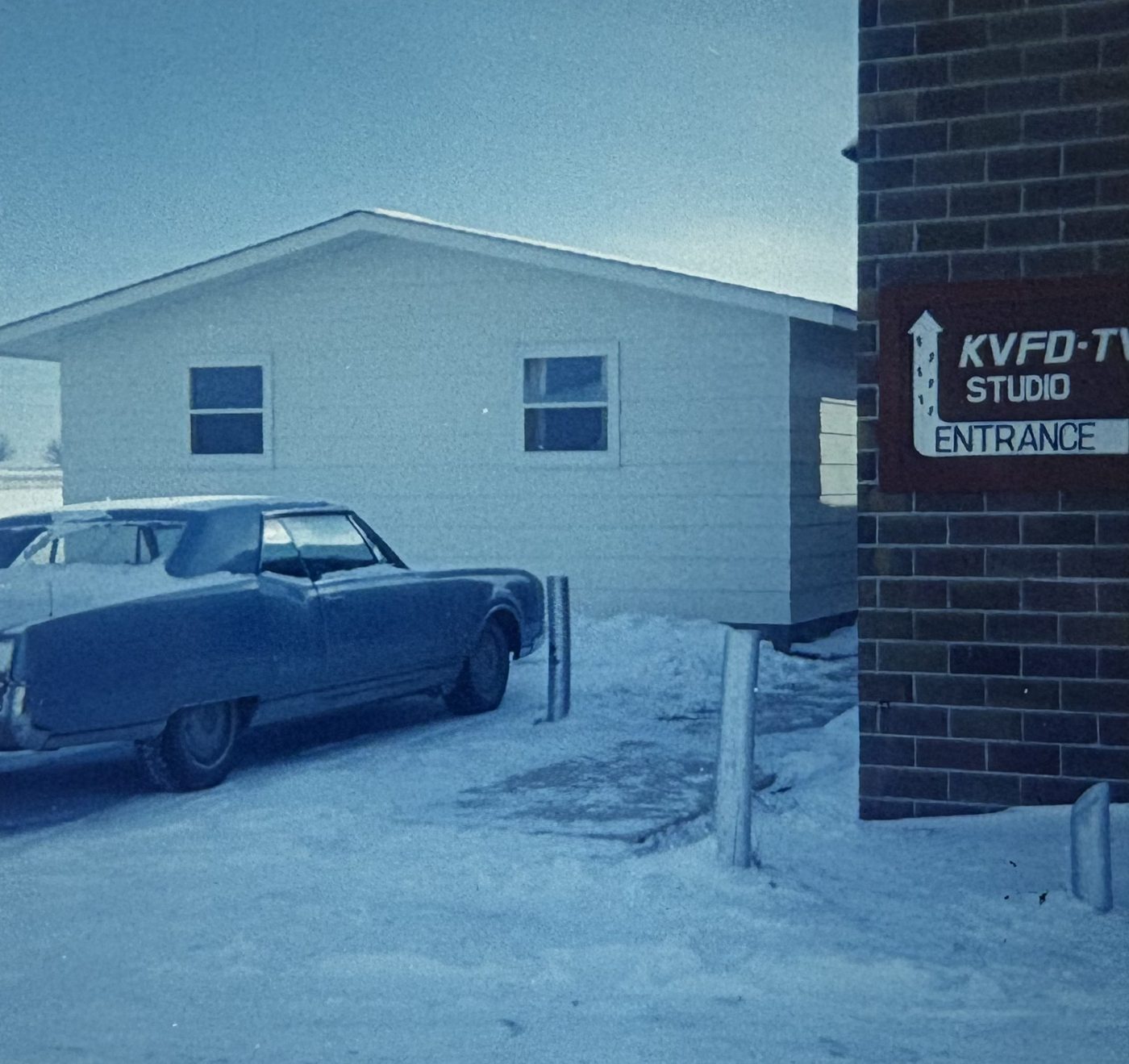
In the late fall of 1958 Breen and cameraman Don Zahrobsky, who worked at the station until 1977, filmed This Is Fort Dodge, a tour of the city's landmarks, schools and industries narrated by Breen. Along the way he points out the Warden Building, home to "the studios and offices of KVFD and KQTV," and the film shows the start of a series of historical markers KQTV placed at points of interest around Fort Dodge. In 1966 the call letters changed to KVFD-TV, matching its radio sister.
Video
This Is Fort Dodge (filmed fall 1958), narrated by Ed Breen (YouTube)
Eve Rubenstein. Her career at the station was a story of its own. When her husband, Charlie, died in 1953, Breen, a close family friend, hired her as a continuity writer; when television arrived a year later, at his direction she launched Eve's Kitchen, which grew from a cooking show into a program on everything from fashion to gardens to 4-H.
She spent nine years as sales manager, and at the start of 1972 she became general manager of KVFD-TV, with Breen as president. Her commercials for the station won her a trip to Paris and London from the National Footwear Institute, and she served as resolutions chairman of American Women in Radio and Television. Asked by the Des Moines Register's Gordon Gammack whether men resented taking orders from a woman, she said, "Yes. But I don't know why."
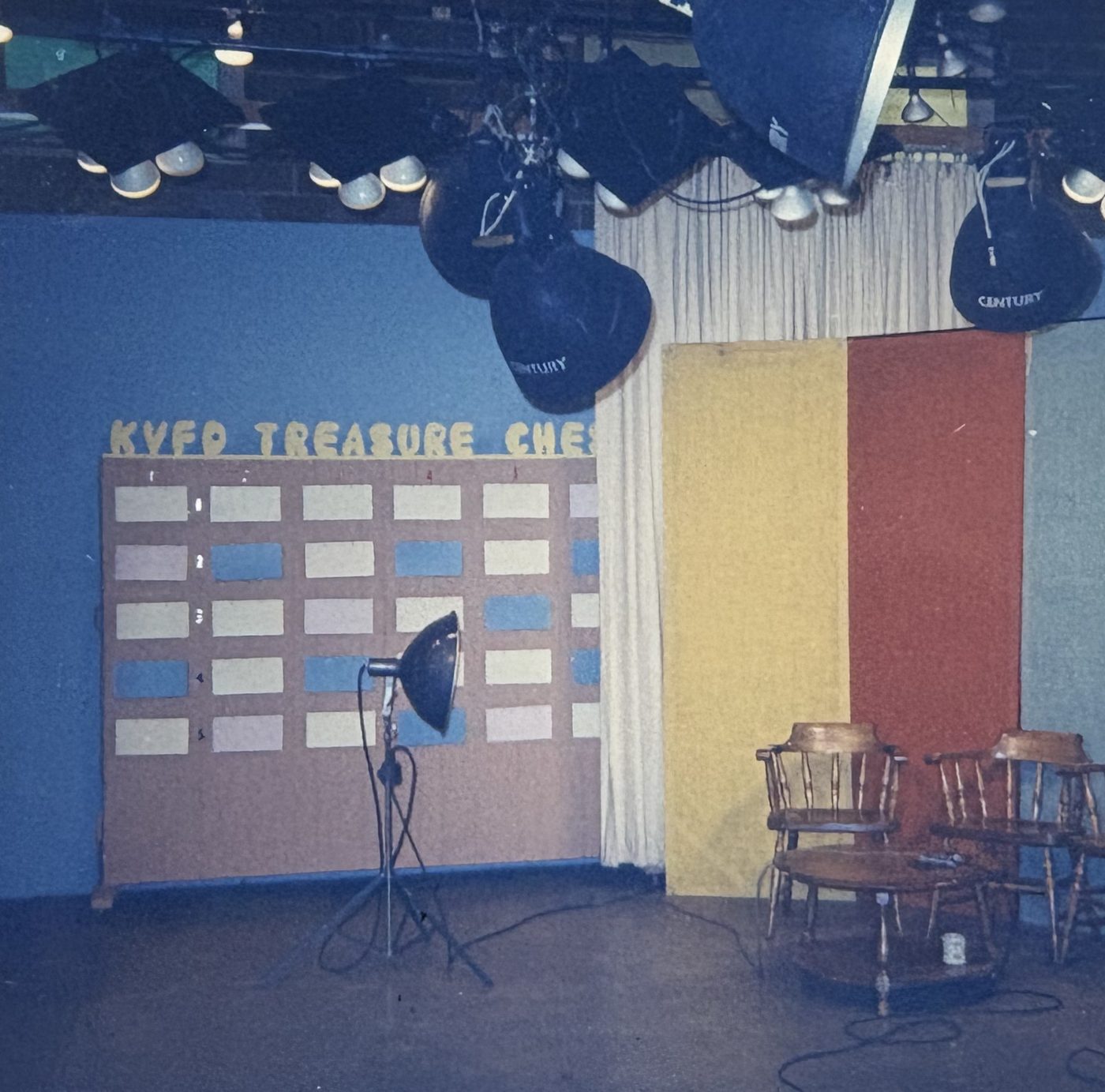
More local programming. Channel 21 filled its schedule with local shows. High School Bowl, a quiz modeled on NBC's College Bowl, with format and questions from John Cleary, longtime producer and director of the network show, was hosted by news editor Bob Tarbox, who joined KVFD-TV in 1969; by the early 1970s 27 schools from as far as 87 miles away played tournament-style for prizes and books for their libraries.
The Garden Club of the Air, set up by Mrs. Hugh Moore and Mrs. Alfred Hansen of Goldfield with the 6th District Garden Clubs, began on May 2, 1960, as a 13-week series and was still running in the 1970s, winning national and regional garden club awards.
Encounter, which began around 1971 at the suggestion of Pastor Stanley Ecklund of Grace Lutheran, put a panel of local ministers in front of viewers' questions every Friday. Churches also had Sermons and Songs with the Rev. D.D. Underwood of First Assembly of God, and the Rev. Lloyd Meyer's Little Country Church of Iowa, which featured rural congregations for nearly a decade.
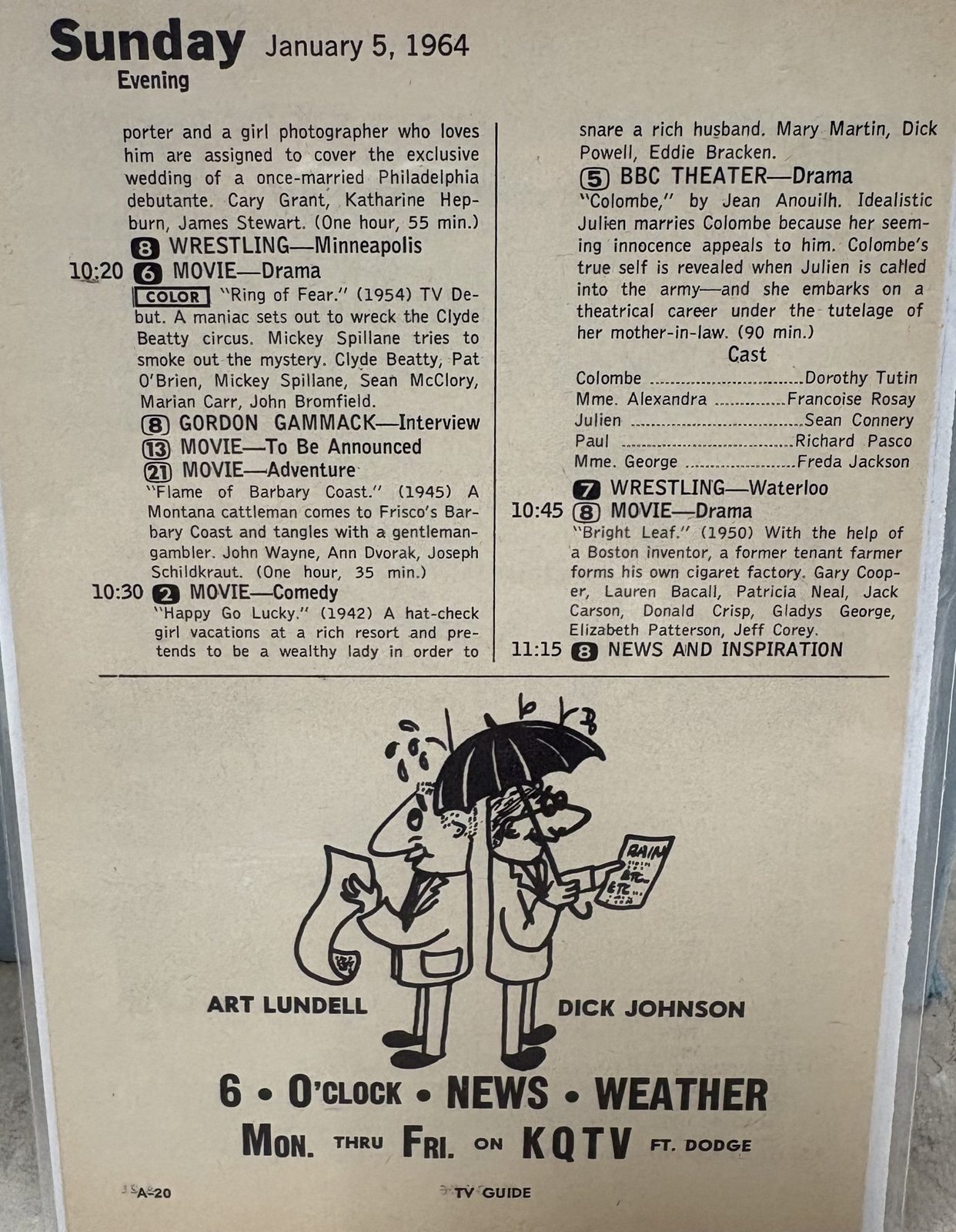
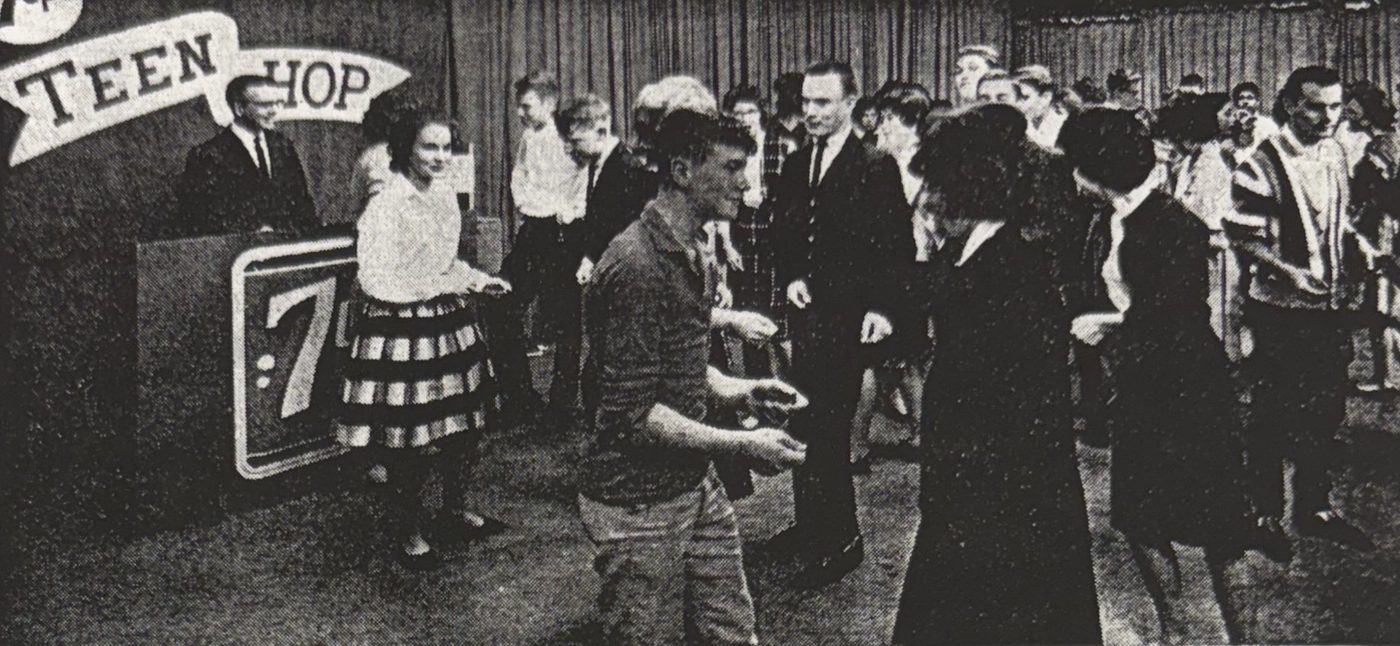
Art Lundell, who went to work for Breen in 1956, hosted the Saturday Teen Hop while also reading the 6 p.m. news on KQTV and working afternoons on KVFD radio; in 1963 TV Radio Mirror called him "the busiest man in Fort Dodge."
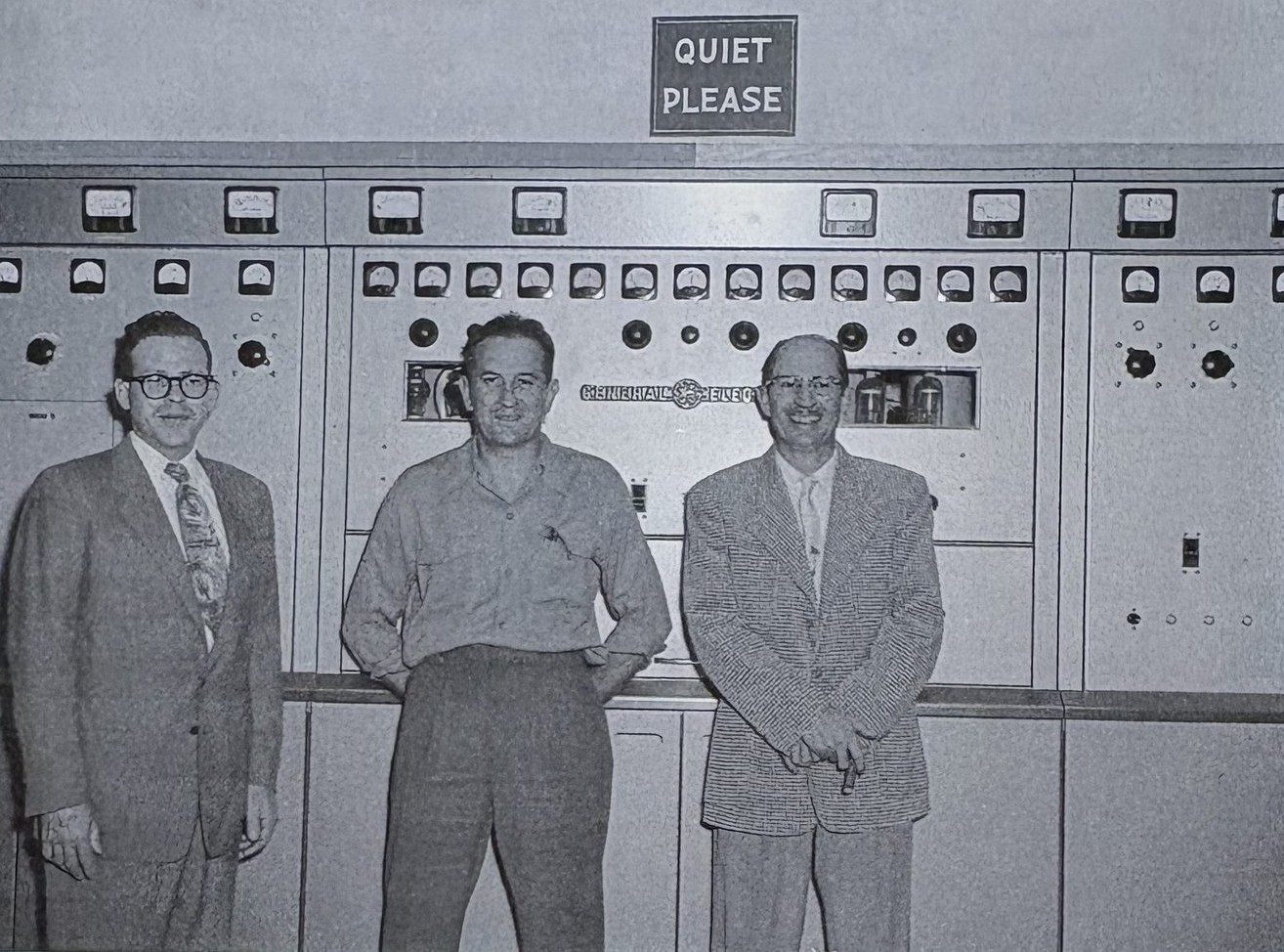
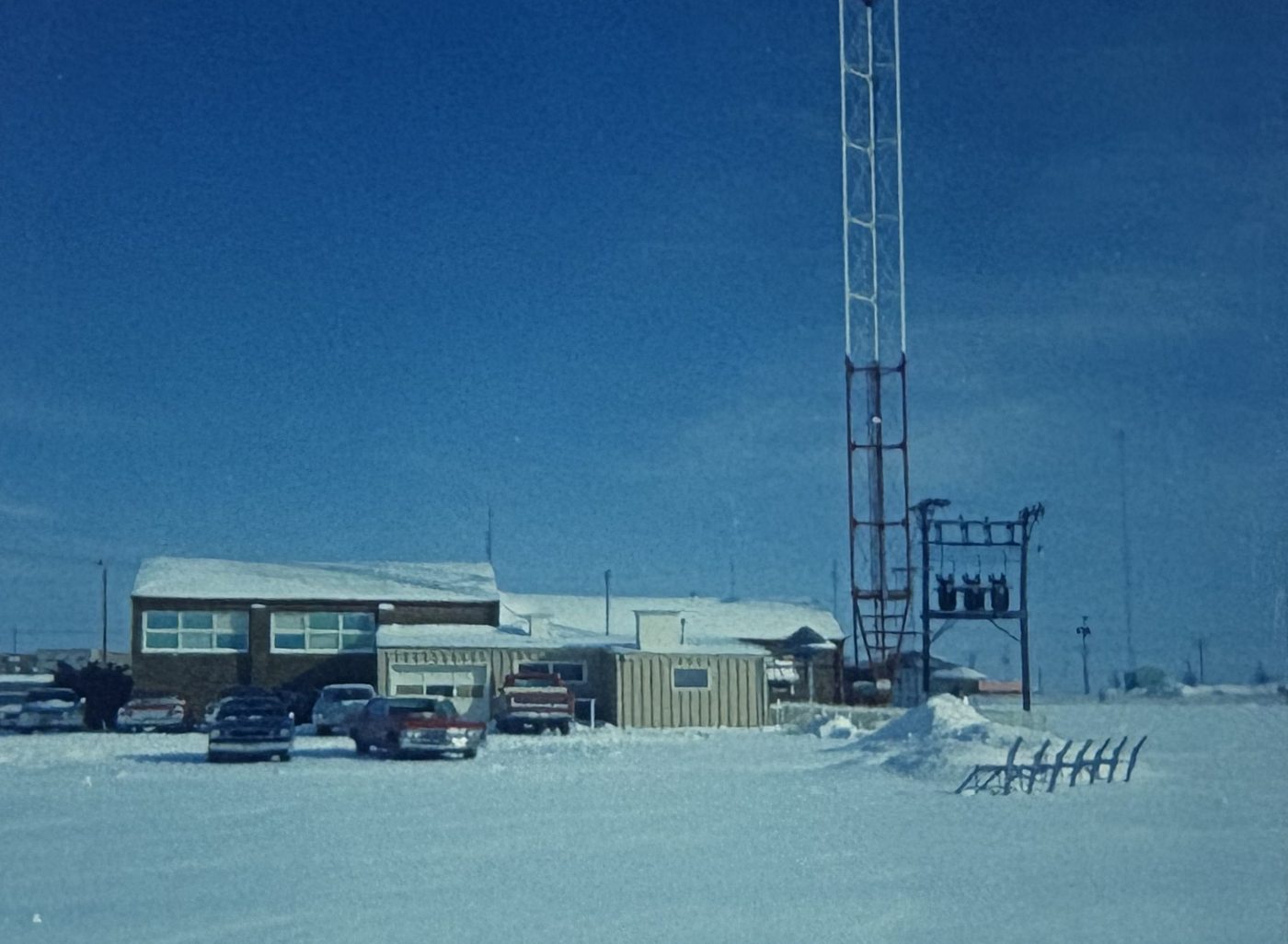
Channel 50. KQTV's studios and original 650-foot tower stood on the edge of Fort Dodge, beside what became the Iowa Central campus; in 1970 the station moved its transmitter to a new 1,200-foot tower at Bradgate, about 25 miles northwest, and raised its power to 414,000 watts. The bigger coverage area never brought in enough advertising, and the station lost money every year after the move.
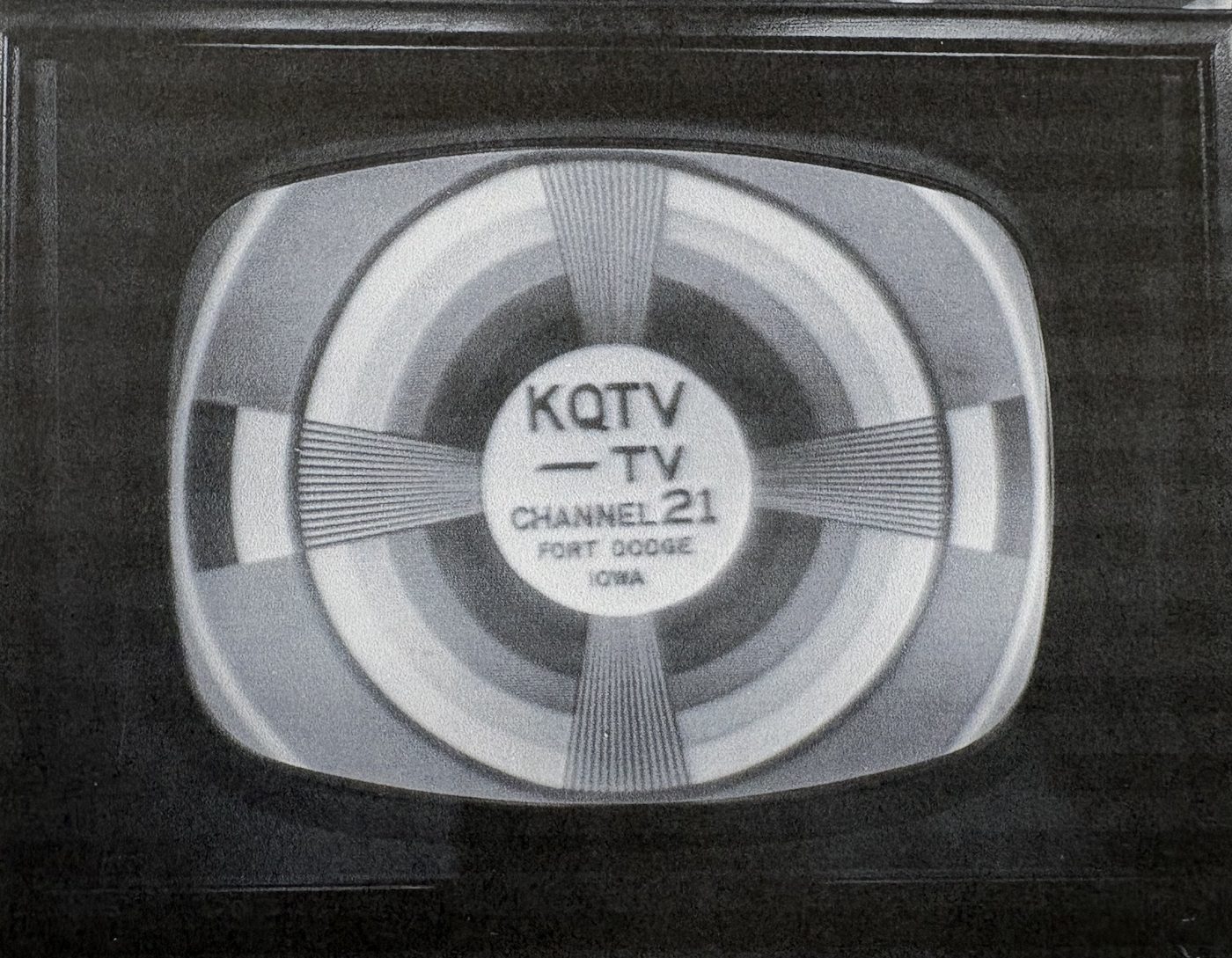
In July 1975 Breen agreed to sell the Bradgate tower and channel 21 transmitter to Iowa's public television network, which held a permit for channel 46 in Fort Dodge; the FCC moved that permit to channel 21. KVFD-TV went back to its original Fort Dodge tower on channel 50 with a used transmitter.
The FCC approved the swap in May 1976, and channel 50 went on the air in March 1977. KTIN signed on from Bradgate on channel 21 on April 8, 1977, less than a month before the tornado.
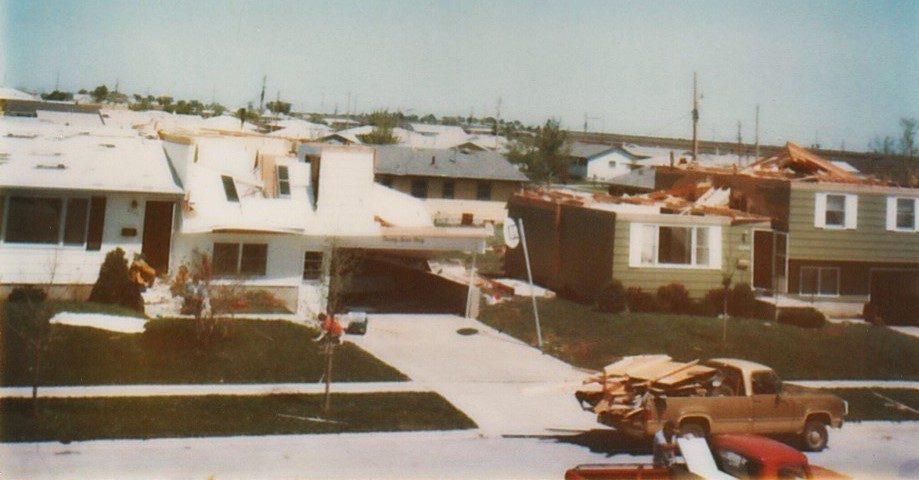
May 4, 1977. That evening an F4 tornado cut a six-block-wide path through northeast Fort Dodge, damaging or unroofing hundreds of homes. The evening newscast was over, and channel 50 had gone to NBC's prime-time schedule, starting at 7 with The Life and Times of Grizzly Adams. The only person in the building was engineer Don Lewis, who was keeping an eye on the weather. At 7:15 a Webster County sheriff's deputy spotted a tornado several miles south of town, the city's sirens sounded, and Lewis put tornado warnings on the air several times. At 7:30 he had just enough time to dive under a steel table before the station took a direct hit. No one at the station was killed. The 650-foot tower was left standing but so badly damaged that it had to come down; ten days later crews from Stainless Tower, the company that had put it up nearly 25 years earlier, returned to dismantle it.
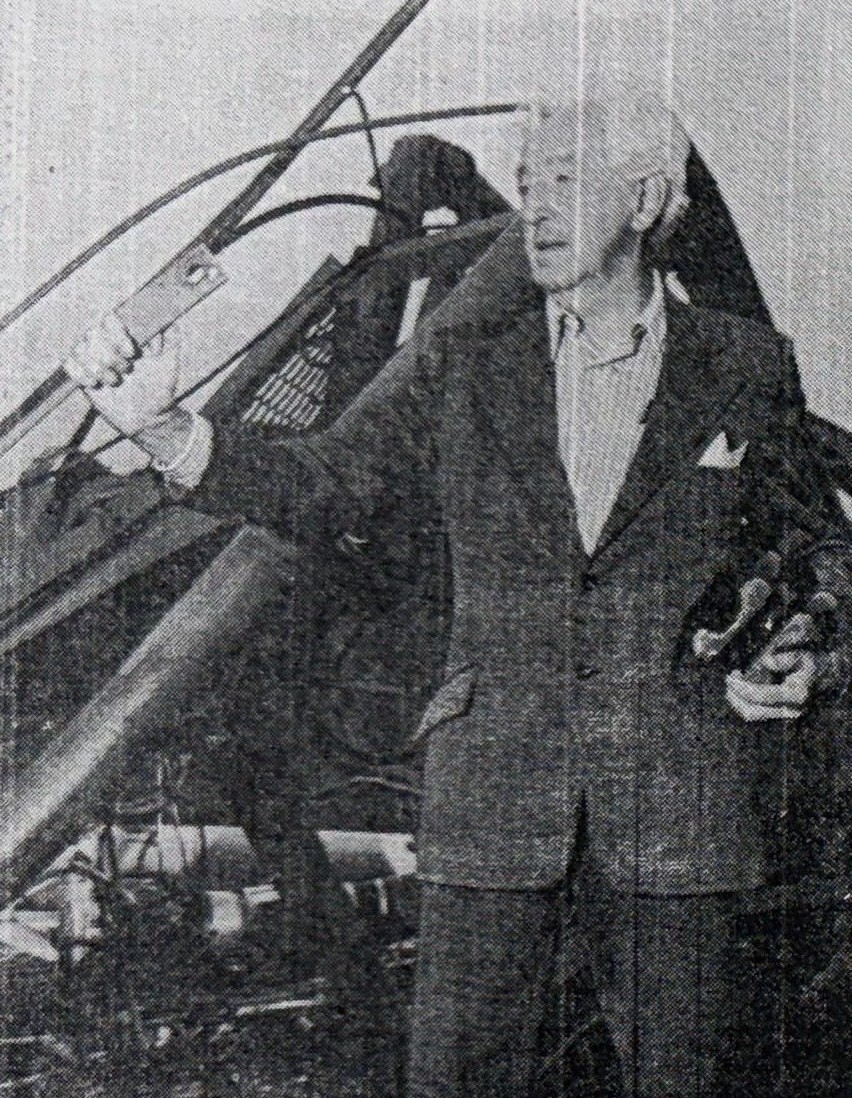
On Saturday, May 14, with Breen and other station veterans watching, the crew cut the guy wires. The plan was to drop the tower to the northwest, but it broke at the tornado-weakened point 250 feet up, and the 400-foot section above flipped back and fell east onto the station building. "Well, let's go see what it hit," Breen said, and strode across the field to look. "He's at his best in a crisis," said Sinclair, the engineer who had put the tower up in 1953. Jim King, the only man to climb the tower after the tornado, directed the job.
KVFD-TV never returned to the air. Breen, 78, had already put the station up for sale, saying no one in his family was ready to take it over, and insurance covered only about half of a loss of more than $500,000. Even so, he planned to rebuild. He told The Messenger it would take $300,000 to $400,000 for a new 650-foot tower and transmitter building and a new studio on the Iowa Central campus, using $615,000 worth of cameras, transmitter and other equipment that had come through the tornado and was stored at Bradgate, and he set a target of May or June 1978 for returning to the air. Two or three buyers had made offers, and Breen said a sale could come even before construction, but he was moving ahead on the plan to put the station back on the air under its present ownership.
He took an option on a new tower site 2½ miles south of town but died before using it, and the FCC deleted the call sign in 1981. The tower and studio building were removed, and the land became Iowa Central's football practice field for most of the 1980s.
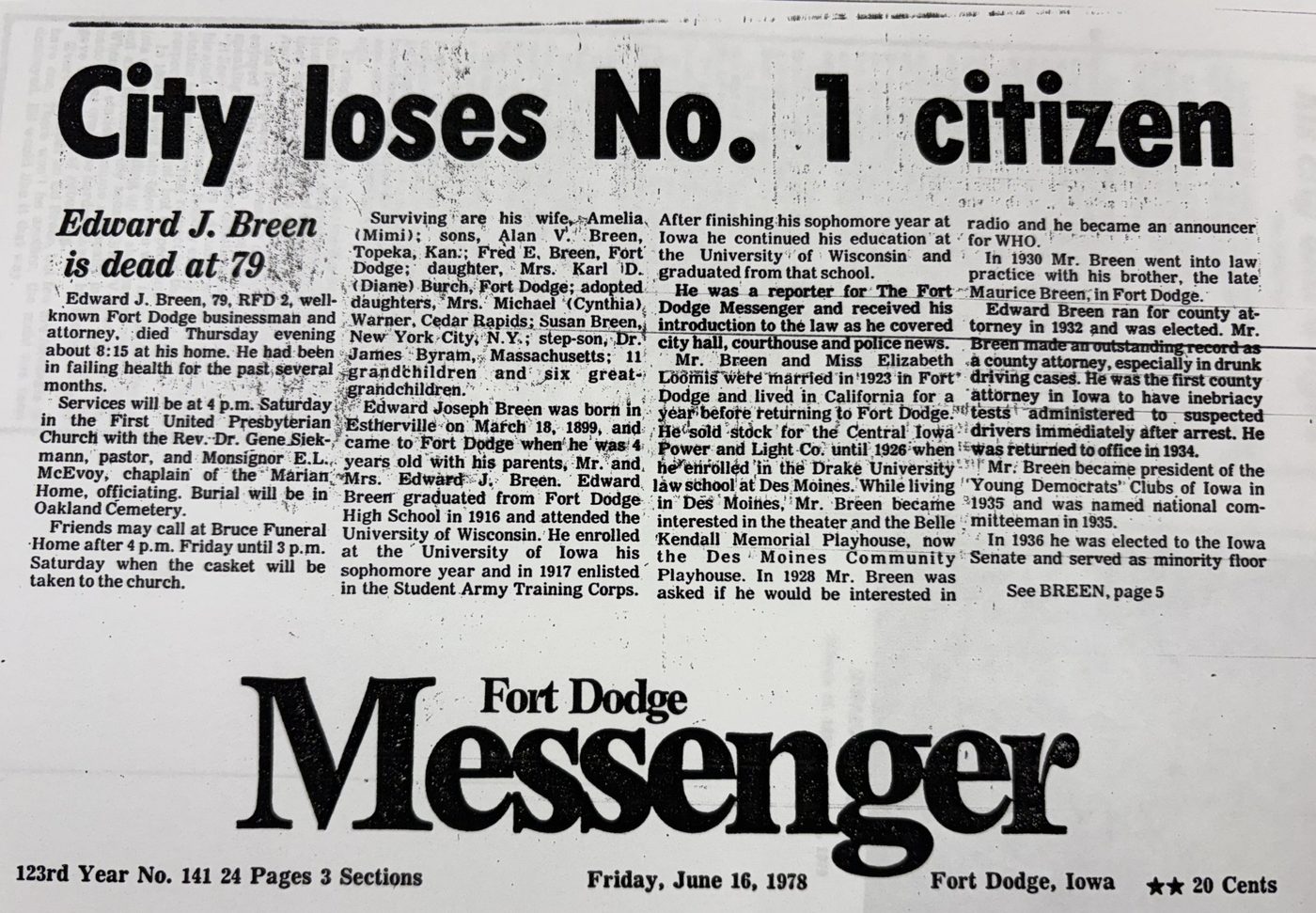
Ed Breen (1899–1978). Born March 18, 1899, in Estherville, Breen graduated from high school in Fort Dodge in 1916 and from the University of Wisconsin in 1921, then came home to work for The Messenger. He was Webster County attorney (1932–36) and a state senator (1937–41), part of that time minority leader. He was the second president of the Iowa Broadcasters Association (1952) and entered its Hall of Fame in 1974. As county attorney he was the first in Iowa to test drivers for intoxication right after arrest.
When Fort Dodge turned 100 on August 23, 1950, Breen put on the birthday party himself, with Adm. Chester Nimitz as parade marshal and more than 40,000 people lining Central Avenue. "Everybody's here but the Cardiff Giant," he said. He died at home on June 15, 1978, at 79, and The Messenger's front page called him the city's "No. 1 citizen." In an editorial, Bob Brown wrote that apart from his family, Breen loved two things, "the city of Fort Dodge and a good, scrapping fight," and closed: "Every city needs an Ed Breen, but few are fortunate to have one."