Fort Dodge Broadcasting: A History · Chapter 1 of 9
Fort Dodge on the air, 1939 to today
Fort Dodge had small radio stations in the 1920s, but its lasting station arrived on Christmas Eve 1939, when KVFD signed on from the Warden Building downtown. Over the next fifty years the city added a second AM, a television station, a string of commercial FM stations, one low-power educational station and one public NPR affiliate.
Most of the stations started local. KVFD and its TV sister were founded by Ed Breen, a Fort Dodge attorney and state senator. KTLB was started by a KVFD ad salesman, KRIT by a Clarion-area radio man back from Oklahoma, KTPR by an Iowa Central instructor, and Fort Dodge Radio by one person with connections to five Fort Dodge stations. Ownership later moved to regional groups and then to national ones. Today the six commercial stations share one owner, Connoisseur Media.
Fort Dodge and the Iowa Broadcasters Association. Fort Dodge broadcasters were part of the Iowa Broadcasters Association from its start in 1951. Its first president was William B. Quarton, head of WMT in Cedar Rapids; Ed Breen succeeded him in 1952, the year before both men put television stations on the air, WMT-TV in September 1953 and KQTV that November.
Quarton's ties to Fort Dodge ran deeper. Soon after KEOK signed on in 1956, he and partner Bill Dolph took it over and renamed it KWMT after his Cedar Rapids flagship, and in 1968, when he retired from WMT, he became chairman of KWMT Inc. Its president and general manager, James W. Maurer, led the IBA in 1969, and Bill Grady, general manager of KVFD and KUEL, was its president in 2001, making four IBA presidents with Fort Dodge ties in the association's first half century. Quarton even had an early link to Fort Dodge radio: he began his career in 1931 at KWCR in Cedar Rapids, the station that had shared the 1310 frequency with Carl Tunwall's KFJY.
Six stations, one roof. Over four decades, Fort Dodge's six commercial stations changed hands again and again, pairing off with sister stations until they all ended up under one owner and one roof:
1966: KWMT and KKEZ become sister stations.
1988: Dodge Communications pairs KVFD with 92.1, the station that became KUEL.
1992: James Ingstad's group buys KRIT from Linder Broadcasting and renames it KIAQ.
1994: Ingstad adds KTLB and runs both stations from KIAQ's offices at 10th and Central.
1997: Three Eagles Communications buys KIAQ and KTLB from Ingstad.
2004: Three Eagles adds KVFD and KUEL from Waitt/NRG.
2007: Three Eagles buys KWMT and KKEZ from Clear Channel and brings all six stations together in the Dowd Building.
2014: All six pass to Digity, then to Alpha Media.
2025: Connoisseur Media buys the group.
Call letters here moved around constantly, so each history below follows one transmitter and frequency, whatever it was called at the time.
| Signed on | Station | Frequency | Later calls | Today |
|---|---|---|---|---|
| Dec 24, 1939 | KVFD | 1400 AM (began on 1370) | — | KVFD, news/talk |
| Oct 1947 | KFMY | 102.7 FM | — | Off the air by the mid-1950s |
| Nov 23, 1953 | KQTV | UHF channel 21, later 50 | KVFD-TV (1966) | Off the air after the May 4, 1977 tornado |
| Apr 1956 | KEOK | 540 AM | KWMT | KWMT, country |
| Sept 1964 | KRIT (Clarion) | 96.9 FM | KIAQ (1992) | KIAQ, "K97" country |
| 1966 | KWMT-FM | 94.5 FM | KKEZ | KKEZ, "Mix 94.5" |
| Sept 1971 | KICB | 88.1 FM | — | KICB, Iowa Central student radio |
| July 28, 1975 | KTGA | 92.1 FM | KSMX, KFTX-FM, KFDC, KUEL, KZLB | KUFX, "92 Rock" |
| Oct 5, 1975 | KTLB (Twin Lakes) | 105.5, now 105.9 FM | — | KTLB, "105.9 The Beach" |
| Sept 15, 1980 | KTPR | 91.1 FM | KNSH (2012), KNSK (2013) | KNSK, Iowa Public Radio |
| Apr 1, 2019 | Fort Dodge Radio | Online (Live365) | — | Fort Dodge Radio, classic rock |
Before KVFD: Carl Tunwall and KFJY
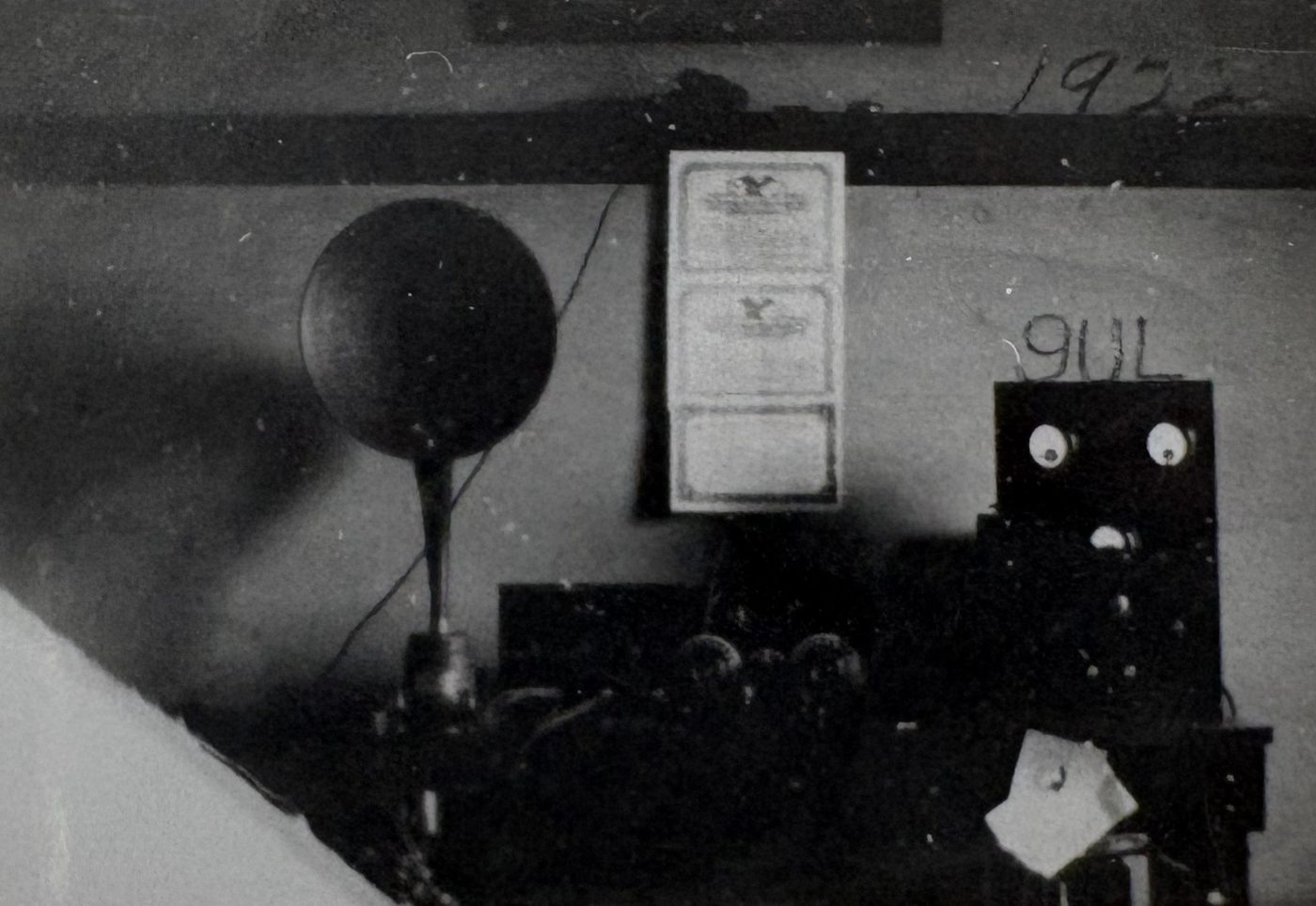
Before KVFD there was Carl S. Tunwall, and by the records that survive he was Fort Dodge's first broadcaster. Born in Moline, Illinois, and orphaned at 10, he was raised by an uncle and aunt and then by the family of Judge Newton Roberts of Ottumwa. His formal schooling ended with the eighth grade, but he built his first wireless set in 1909, and in World War I he served in a radio platoon of the Army Signal Corps in France, where he also helped install radios in planes of Eddie Rickenbacker's squadron. His brother Roy, a supervisor at Fort Dodge Gas & Electric, encouraged him to settle in Fort Dodge after the war. He worked at the hydroelectric dam before opening a radio store, and in 1922 he married Gertrude Mueller. According to local historian Roger Natte, Tunwall's 1920 demonstration of broadcasting at the Hawkeye Fair "created a sensation," and his transmitting set was used again in a John's Dry Goods Co. demonstration advertised for March 4, 1922.
That spring the Standard Radio Equipment Co., which sold Atwater Kent radio sets and parts, put WEAB on the air from rooms 619–23 of the Carver Building and sold time on the air. Licensed May 25, 1922, on 360 meters, the wavelength nearly all early stations shared, it was one of only five broadcasting stations in Iowa that June, along with stations in Ames, Centerville, Davenport and Des Moines. Tunwall was the company's treasurer and its announcer, and Bill Davis was its engineer. WEAB's license was deleted October 30, 1923, and the company failed the next year, according to Ronald Tennant, whose older brother, Carleton, ran its stockroom.
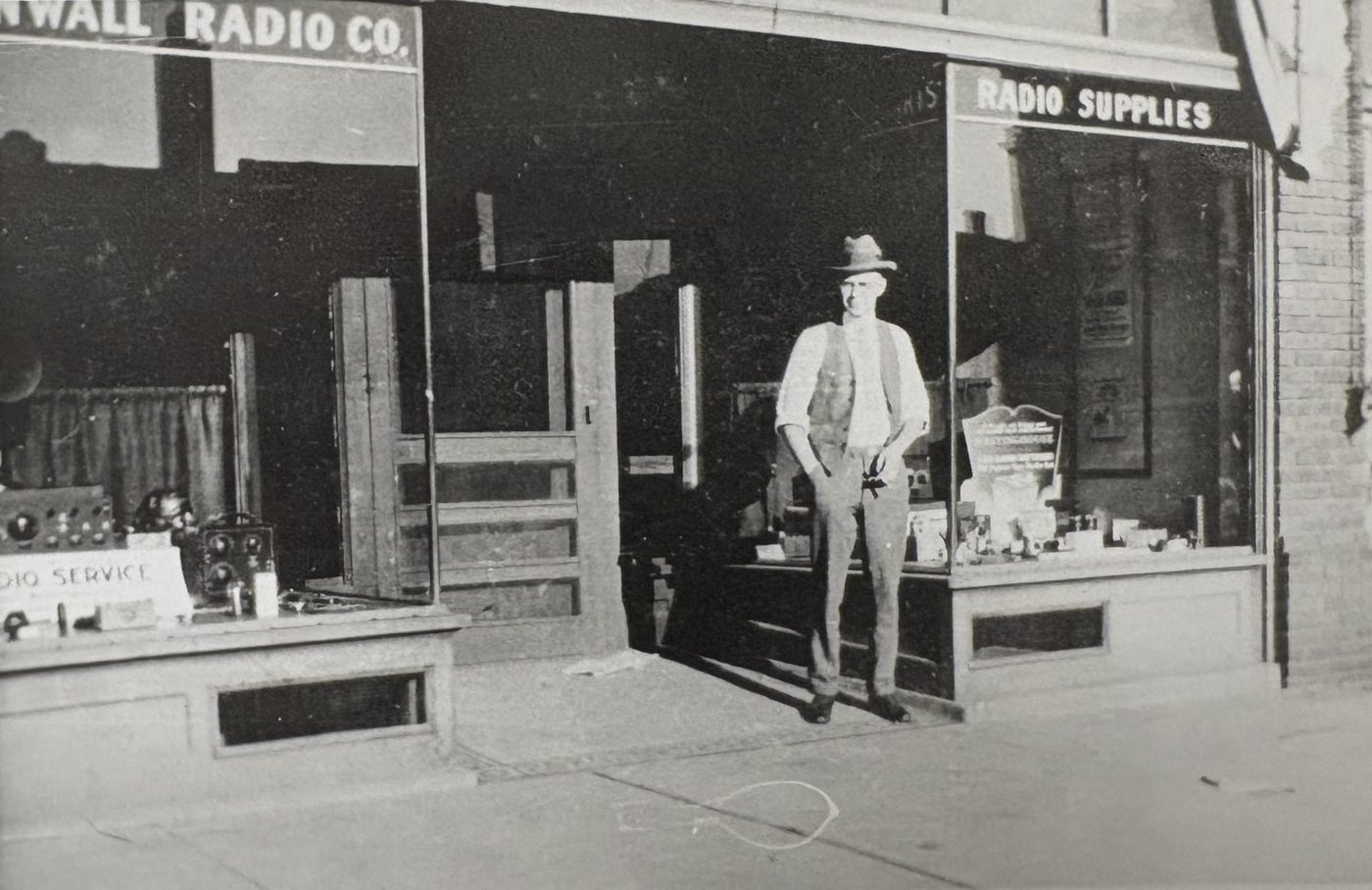
By then Tunwall had his own Tunwall Radio Co., first at 13 North 10th Street, and on September 23, 1923, he put KFJY on the air. The Commerce Department's Radio Service Bulletin of October 1, 1923, announced it as a new station: Tunwall Radio Co., Fort Dodge, 50 watts on 246 meters, or 1220 kilocycles. In September 1924 The Messenger described its schedule: market reports, farm news and weather every evening at 6, orchestra music from the Princess Theater on Wednesday nights, and church services alternating between First Baptist and Bethlehem Lutheran. By 1927 Tunwall and Carl Anderson were its announcers, with music from 10 to 11 a.m., weather, markets and current events from 5:45 to 6:15 p.m., and a special musical program every Tuesday night; organist Frank Voelker of the Strand Theater was a favorite. The Messenger teamed with KFJY and the Fort Dodge Telephone Co. to broadcast primary election returns on June 8, 1926.
For a small station it carried a long way. A postcard from Belfast, Ireland, verified a KFJY market report, and by early 1927 listeners in 41 states and Canada had written in, averaging 75 letters a day and twice that during prize contests. "We have built up a good reputation throughout the state for the clear quality with which our station is received," Tunwall told The Messenger in February 1927. Like most small stations of the day, KFJY was moved around the dial: it was on 1250 kilocycles at 100 watts by 1927 and on 1290 by April 1928, and in the Federal Radio Commission's nationwide reallocation of November 11, 1928, the station, licensed to C.S. Tunwall, moved to 1310 kilocycles, still at 100 watts, sharing time with KWCR in Cedar Rapids.
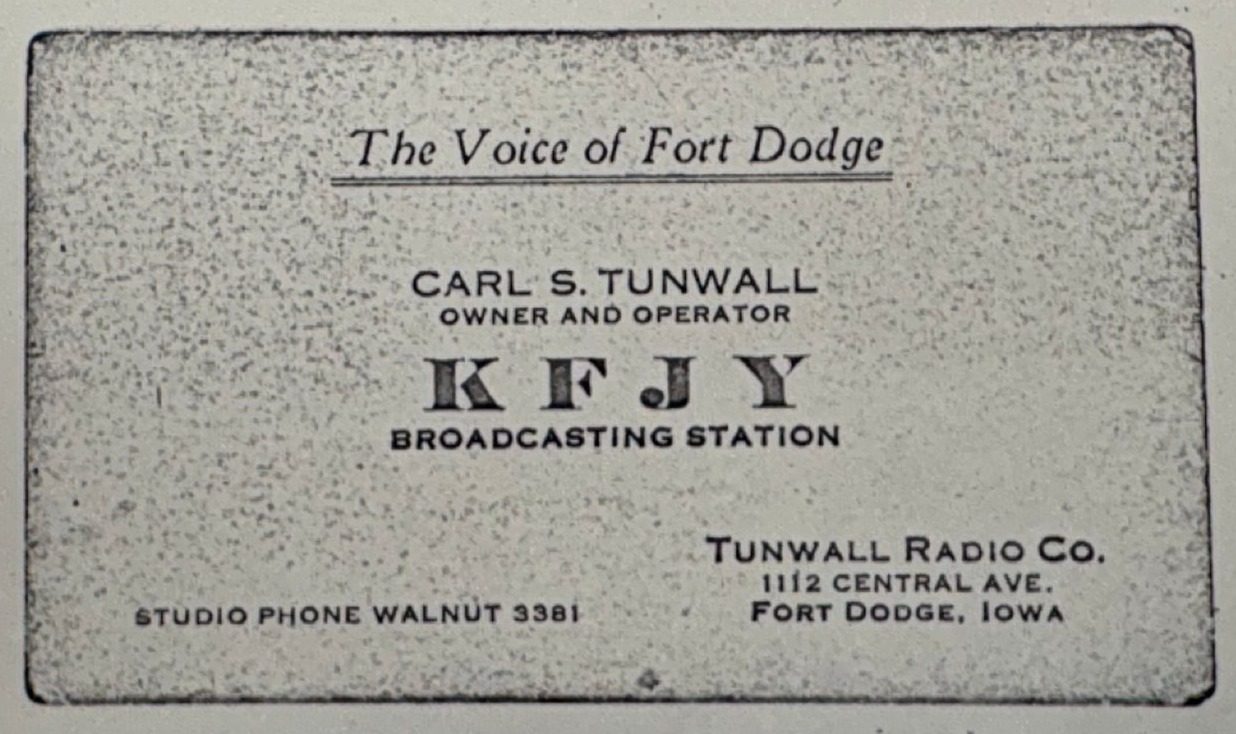
City directories place the studio at 1004 Central Avenue in 1927 and 1928 and at 1112 Central in 1929, the address on Tunwall's business card, which billed KFJY as "The Voice of Fort Dodge." By 1930 the station had moved to Riverdale. Tennant remembered playing in the high school band when it broadcast from Tunwall's Central Avenue studio in 1930. KFJY was not the only voice in town: in September 1924 The Messenger counted two stations, both on North 10th Street just off Central Avenue. The other was KFER, a 10-watt station on 1300 kilocycles run by H.E. Giltner of the Auto Electric Service Co., which broadcast Sunday services from the First Methodist Episcopal Church and organ recitals from the Majestic Theater. KFER appears in station lists from late 1924 into early 1925 but is gone from them by September 1925.

KFJY was still listed in 1931, on 1310 kilocycles from Riverdale, but no Fort Dodge station appears in the 1932 lists or in the first Broadcasting Yearbook in 1935. Natte wondered whether it was a victim of the Depression; Tunwall had left the radio retail business in 1929. He had hoped to join the KVFD staff when it opened in 1939, his children later said, "but that didn't happen." Instead he ran a radio repair shop from his home at 1520 Fourth Avenue South from 1934 to 1946, and in 1944 the FCC registered his amateur transmitter there. He was an associate member of the Institute of Radio Engineers. His son Carl Jr. worked with him in the radio business for a time, and Carl Jr. and his brother John both became ham operators. Carl Jr.'s son, Steve Tunwall, followed his grandfather into radio and later founded Tunwall Radio LLC, which made transmitter control systems for broadcasters.